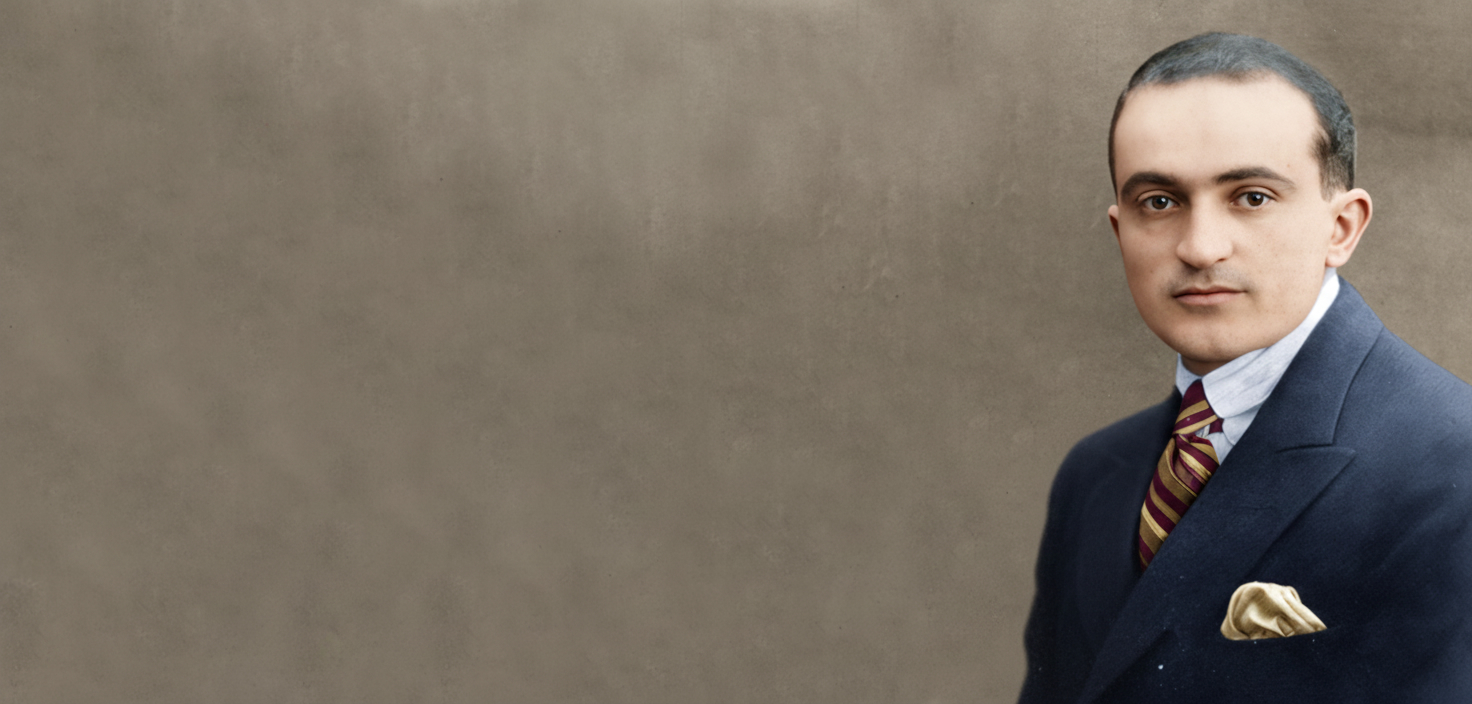
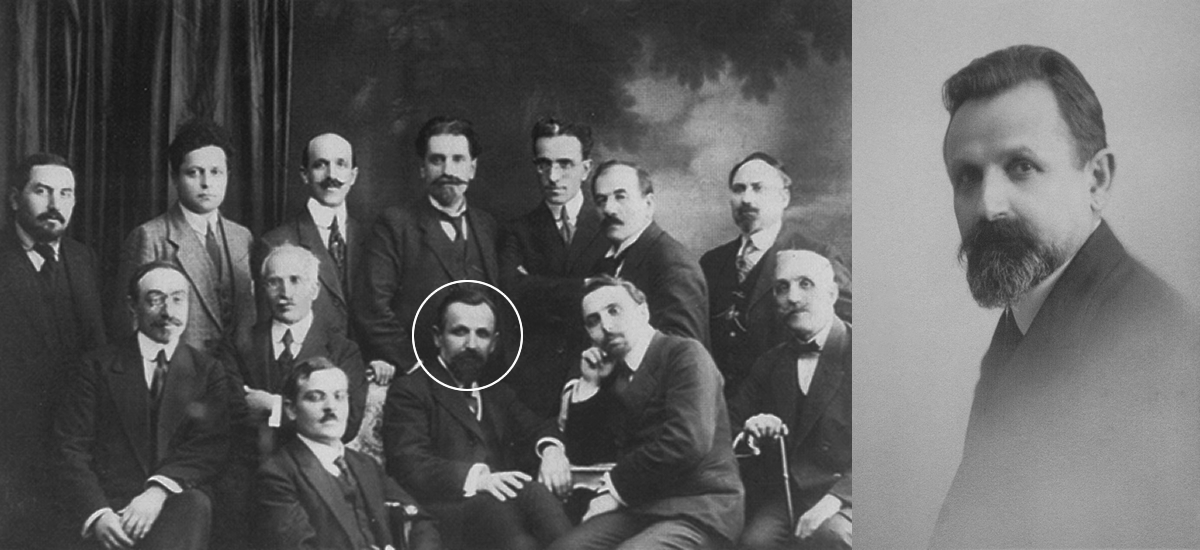
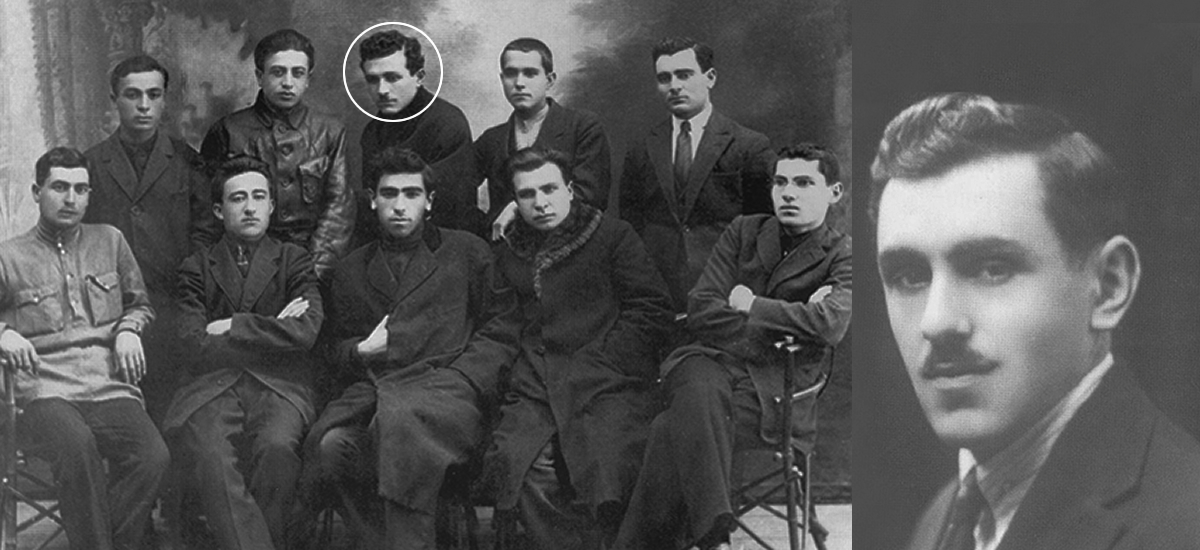
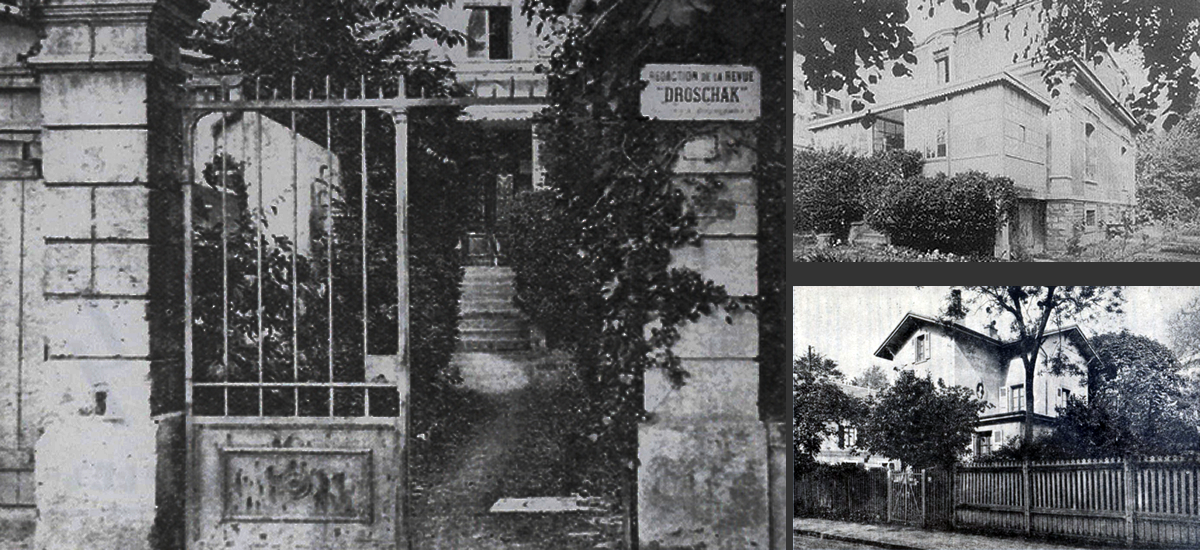
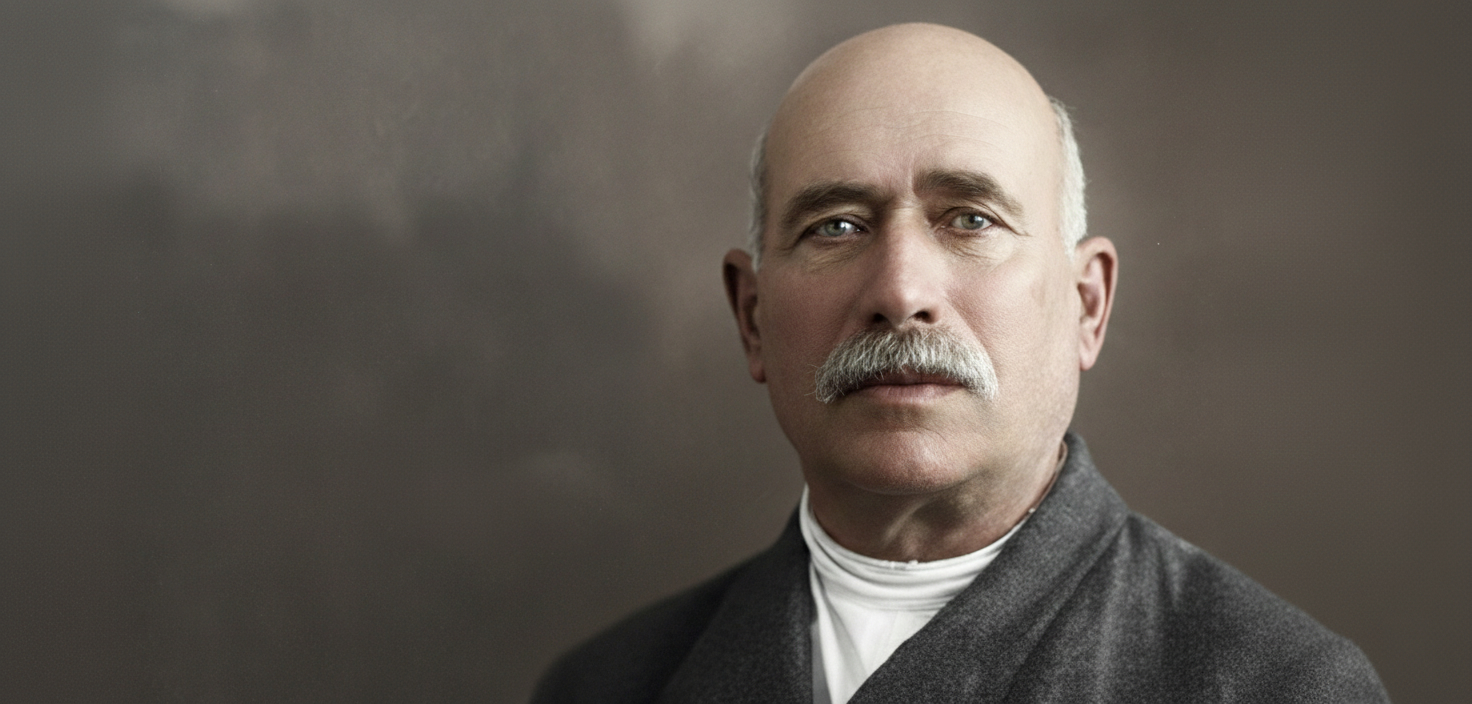
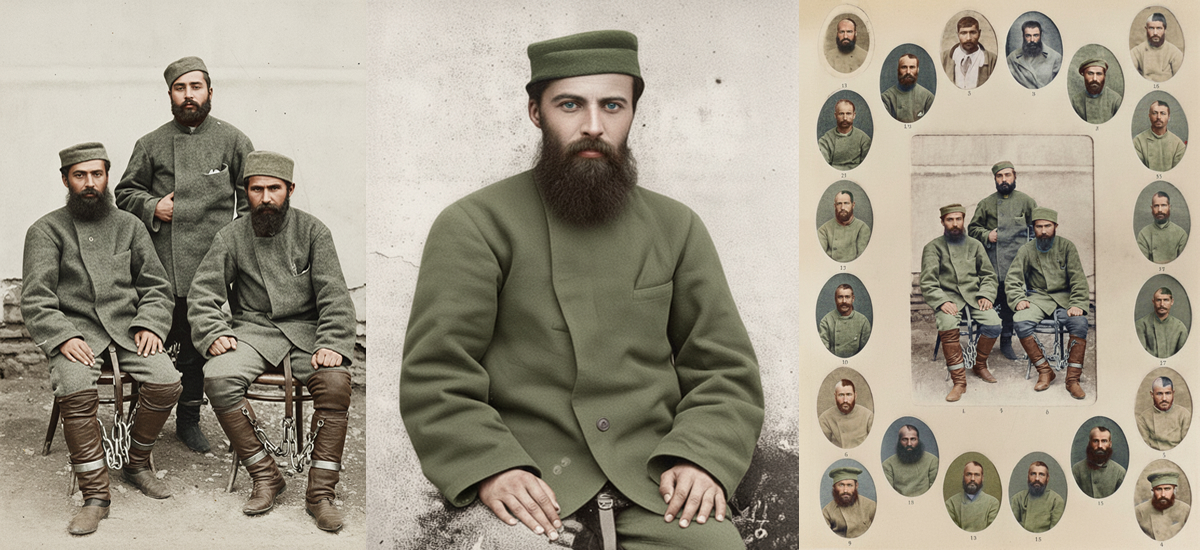
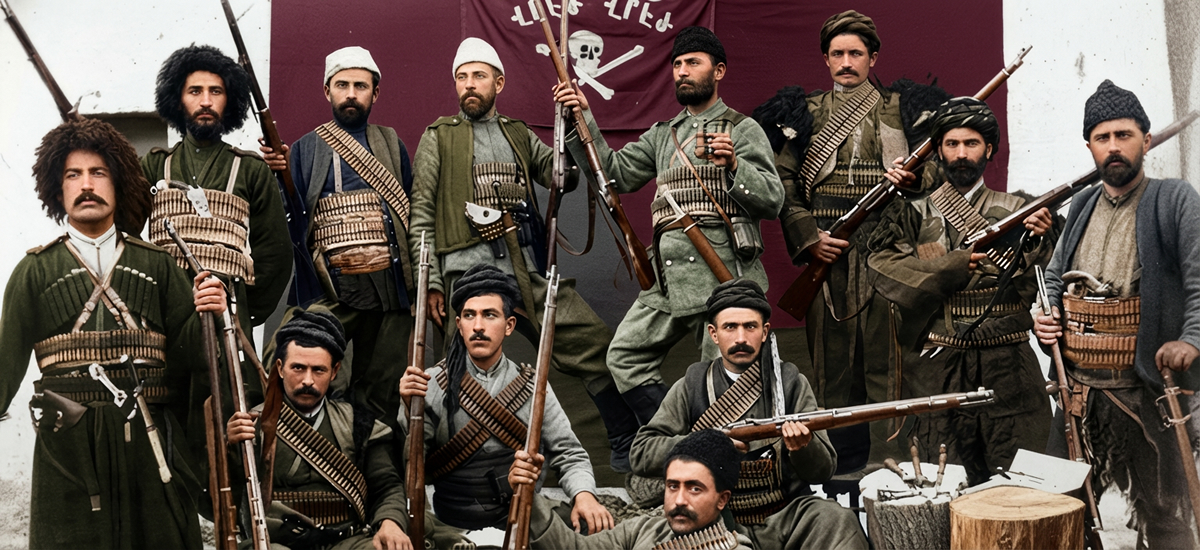
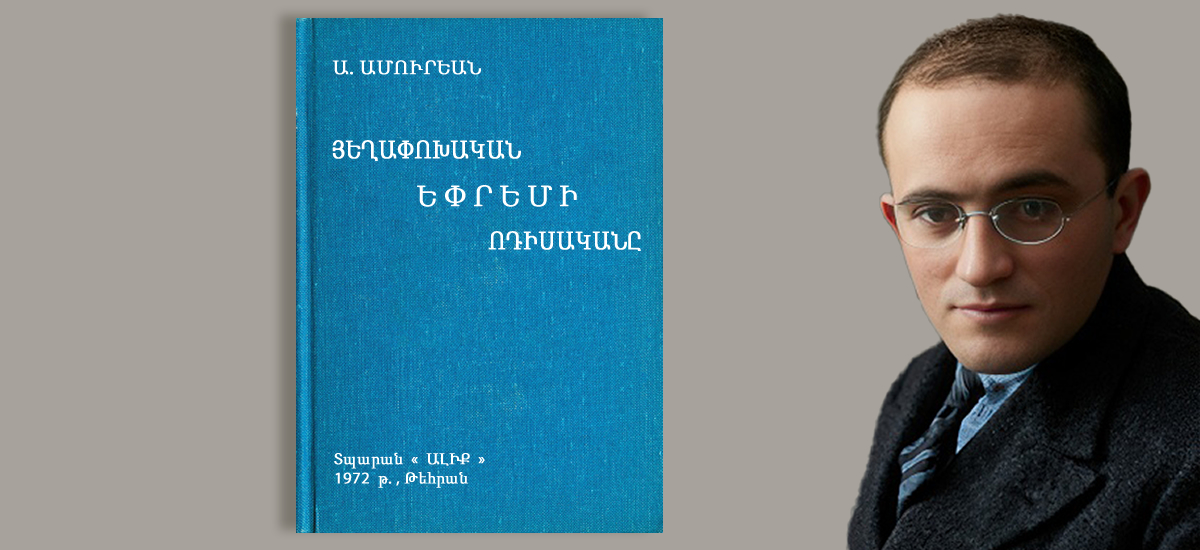
Under this number and this column heading, we begin the presentation of the memoirs of the well-known ARF veteran Andrée Der Ohannessian (A. Amurian). This volume of memoirs, titled "Pages of Life" and bearing the inscription "From Childhood until 1936," has been made available to us by the ARF Bureau. Due to understandable journalistic necessities, we are publishing the manuscript by selecting excerpts from it. The period of this first excerpt is the winter of 1917-1918.
This column, aspiring to the publication of unpublished works or the re-evaluation of "Old Pages," will be a permanent presence in "Droshak."
I lay for three days at my maternal aunt's house in Tiflis, then got up. They wanted two delegates from two grades of the seminary for the Armenian Student Congress, which was to take place in Baku; the boys from our class had elected me, and from the upper class, they had elected Vartan Hovhannisyan (V. Astghuni); both of us were from Tabriz.
I was to meet comrade Hamo Ohanjanian's son, Monia Ohanjanian, regarding the trip to Baku. I went to Monia's house. He received me warmly. Monia was a seventeen-year-old boy, my age, handsome, with a Greek profile, his hair combed to one side. He was a Russian speaker (from Hamo's first wife, who was Russian). He was wearing the uniform specific to the Lisitsian gymnasium. Monia's room was very simple: a few books and notebooks on the table, one or two sports equipment in the corner.
We spoke in Russian. Monia said that Vartan and I should go to Baku, and he would also come with his friends.
The congress began. The central figure was Monia. Also notable were Yegia Chubar and Amatuni* (in 1926-27, he was sent to Paris by the Bolsheviks; he edited the "Yerevan" newspaper and attacked the ARF. Amatuni also became an important figure in Soviet Armenia. In the end, the Bolsheviks "liquidated" both of them... A.A.). While giving a speech, Chubar even quoted those lines from A. Isahakian's poem which say: "For a thousand years, and even more, the Tatar has knelt on our chest." That's what they said, and in the end, they became Bolsheviks.
During the proposals section, I asked for the floor and dictated that Armenian students must study our history well, read our chroniclers—Movses Khorenatsi, Yeghishe, Ghazar Parpetsi, etc., become aware of our national demands, and feel proud of our past.
The audience applauded, while the organizers treated it with disdain. They had a similar attitude when greetings telegrams were to be sent; I proposed also sending a telegram to Etchmiadzin, to the Catholicos of All Armenians. The majority was in favor.
The greeting speech was given by Simon Hakobyan, the editor of "Arev," the ARF organ in Baku.
During the breaks, Armenian young ladies hosted us with pastries, tea, and lemonade. They spoke Armenian in their parents' dialect, mixing in Russian.
During free times, we went to the Baku port. For the first time, we saw hydroplanes; they were constantly flying.
We returned to Tiflis from the Baku Armenian colony. The situation on the Caucasian front was chaotic; the Russian troops were retreating like a headless herd, they were heading "home." The National Council and the ARF were rising to form national military units and send them to the front.
In those days, Monia Ohanjanian convened a student meeting in the hall of the Tiflis City Administration. The hall was packed. Monia was sitting behind the table; next to him was student Hrant. Both were ardent patriots.
Monia explained the political situation, then called for students to volunteer to go to the front. We all agreed, appreciating Monia's proposal.
The call of Dr. Jakob Zavriev, addressed to the students, to volunteer and depart for the front, resounded.
My close classmate, Stepan Shahgeldian (from Kishinev) had briefly gone to Erzurum and then returned. I had him tell me about the front and Turkish Armenia. I couldn't get enough of listening. I told Stepan that I was volunteering. He said: "I will go with you to the Erzurum front again." I was happy.
Dr. Artashes Babalian was registering the volunteers; when I was about to go up to his office, I met Mushegh Santrosian, a graduate of our seminary. He complained: "Brother, what kind of man is this Babalian?" They had had an argument and Santrosian had left.
When I entered, Babalian was on the balcony watching the street traffic. He came and asked what I wanted. I said I had come to register as a volunteer, that I was from the seminary.
- We will send you to Khnus, to Colonel Samartsev's headquarters, as a clerk. You will receive one hundred twenty rubles per month...
I cut him off, saying that I was volunteering, not to be an official, receiving money...
- Why, will the money burn a hole in your pocket?
- Yes, - I said, - an official is one thing, a volunteer is another...
Babalian conceded, wrote two papers, one for my insistence, the other to receive clothing and boots from the military depot.
The city of Sarighamish was a kilometer away from the station. There was no means of transport; we had to walk. But it was a dark night and dangerous; Russian (deserter) soldiers could attack us. At that moment, as if from the sky, student Hrant appeared near us. "Boys," he said, "form two lines, I will walk behind you. I have a Browning pistol, I will protect you."
We did just that and, slipping, groping in the dark, we walked to the Sarighamish headquarters, where we were received by Hnchakian captain Pandukht, who was the head of the headquarters.
The so-called headquarters were two spacious shops, with crates lined up against the walls containing dynamite and bombs. Also a few rifles leaning against the walls. Behind the shops was a large courtyard, like a caravanserai.
(...) We were to depart for Erzurum by military truck. We were joined by the wife of the well-known ARF youth leader in the Caucasus, Hampig Cholakhian, Asheen Cholakhian, who was wearing a fur military jacket and sapogi (high boots) on her feet. Her hair was cut short; her face was not beautiful.
She immediately became friendly with Stepan and me; she had the truck's tarpaulin pulled down so the cold wouldn't penetrate inside too much.
Anyone who hasn't been in Western Armenia cannot have an idea of the frigid winter there, 35-40 degrees below zero, sometimes even more. The mountains and plains are covered with a thick layer of snow and ice. The surface of the rivers is covered with ice; people cross the river on foot and on horseback. For the months I was on those fronts, I didn't see the sun. From Köprüköy to Erzurum, we didn't see a single tree. Only Sarighamish is forested, beautiful....
The cold penetrated inside; it was already cold inside too; the cotton sewn into our jackets and military trousers and coats didn't help, nor did the woolen socks.
Before reaching Erzurum, we had to cross the Deveboynu mountain pass. "God forbid we get caught in a blizzard, or we'll be buried under the snow," our companions said. Fortunately, it went well, and we, frozen and tired, reached Erzurum, where we entered through a thick wall's gate, the path from which went upwards for a short distance.
We got off at the door of the Erzurum military headquarters. As soon as we entered, we met our seminary supervisor, Yervand Hayrapetian, who was engaged in orphan collection work on behalf of the Cities Union. He received us with love, feeling proud that seminary students were volunteering in large numbers. He said that for now we should sleep in the military barracks and eat at the headquarters.
We went out to stroll around the city. Snow-winter, sleds were operating, pulled by one horse. Everything had a military look. We met our classmates Yeghishe Zarutian, Yervand Zakarian, Western Armenians Hovakim Guloyan, Armenak Srapian, Haykaz Ghazarian from Vagarshapat, Hovhannes Manukian from Akhalkalak, Nahapet Kurghinian from Ashtarak, all from our class.
The next day, our comrades took us to see the Armenian church and the Sanasarian School. In the courtyard of the Sanasarian School, we saw the bust of the benefactor Sanasarian. The Armenians of Erzurum were absent, looted, exiled, massacred; the institutions and houses had become owls' dwellings. Our hearts bled...
We had a lot of free time; we asked the boys what they were doing; they said they were mostly engaged in target shooting. We gladly joined them; we hadn't fired a rifle yet.
Our training proceeded quickly; we became well-trained in marksmanship.
My concern was the front. The front was a thousand kilometers long, from Trabzon to the Persian border; its depth was 300-400 km. Against the retreating 300,000 Russian troops, we had barely 20-25,000 Armenian soldiers, fedayis, and volunteers; this was a very small force against the Turkish army of at least 200,000.
Therefore, our retreat was inevitable.
With this thought, I wrote a letter to the Armenian National Council in Tiflis, proposing that part of the weapon depots be moved to the rear, so they wouldn't fall into the hands of our enemy. I received no answer. (Years later, in Tabriz, when I told Nikol Aghbalian about this, he said: "Imagine, I proposed the same thing in Yerevan, that part of the depots be moved to the New Bayazet region, to the rear, but no one listened to me").
(...) East of the village of Köprüköy, barely a kilometer away, is the historical bridge, under which the Araks flows, covered with ice in those days.
(...) I often went alone, stood on the bridge, surrendering to sad thoughts, because I felt that one day we would lose these our ancestral lands due to lack of strength, and my tears flowed...
On the other side of the bridge was the former Armenian village called Yaghan, all of whose inhabitants had been massacred by the Turks. The Armenians of the village of Köprüköy had also been massacred, their houses destroyed, even the logs taken away, carried off...
(...) In the evenings, Tsaghikian, Vartzakep, and the Nersisian youth Gevorg were often absent. One day I asked Gevorg where they were going. He didn't hide it; he said they were hunting Turkish spies in the rear; then he told the following: "We caught a giant Turkish spy, he was denying it; we searched him, found letters and papers on him; he was a spy. We demanded he confess, he refused; the comrades fired and wounded him in two places; he was kneeling, wouldn't fall; he said, 'Finish me off, so I can rest,' I approached him and emptied my pistol into his temple, he fell, died...."
Once, when there was talk about that, I said that in such cases the spy should be handed over to a military tribunal, and then dealt with. "André," said Vartzakep emotionally, "fifty people from my family were massacred by the Turks, they were not spies; do you want us to deal with a Turkish spy through a tribunal...?"
One evening, a passenger car stopped in front of our headquarters. "It's Andranik," they said; we were all excited. The arrivals were Andranik, Dr. Jakob Zavriev, a Russian general, and Hamlik Tumanyan (Hovhannes Tumanyan's son). I had seen Andranik passing through Yerevan Square in Tiflis; I had seen Hamlik at the Gevorgian Seminary, where he came to the class above us, stayed one year, and then didn't come again.
Everyone gathered around Andranik to see what the Pasha was saying. Andranik had rheumatism; they lit the stove well, and also put a hot water bottle at his feet. They began to talk; every word of Andranik's was taken as a command. Andranik spoke about the defense of the front, the retreat of the Russian troops, the grave situation created for the Armenians....
(The fall of Erzurum will signal the general retreat. With the wave of retreating army personnel and people, the young volunteers will approach the Russo-Turkish pre-war border line and Sarighamish).
We walked through the snow, up, down, through blizzards and storms; finally we reached near Karaurgan. About 200-300 steps remained to the barracks when we fell, exhausted, on the snow, and slept...
Someone is shaking us, saying: "Boys, you will freeze here, get up, let's go..." It was a young Armenian soldier who interrupted our very sweet sleep. He took us by the arm and almost dragged us towards the barracks.
The barracks were warm; the Armenian soldiers fed us. In Sarighamish, we didn't know where to stay, when seminary student Hovhannes Gyulnazarian from a higher grade came out to meet us and led us to the barracks where he was staying. (...) Right at the entrance of the headquarters, on both sides, two horses had frozen, turned into statues in a rearing position... A sculptor could not have done a more successful job than nature had done. In those days, the poor horses, abandoned by the troops and without food, emaciated, wandered the streets stumbling and would fall somewhere, die....
We were near the headquarters and were admiring the frozen, rearing horses with amazement, when Monia Ohanjanian and student Hrant appeared. We talked about the situation; I expressed dissatisfaction about the retreat and the leadership's inability to organize resistance. Monia said that there had been resistance in Erzinka and that Hrant had also been wounded. Later I learned that Monia had been awarded a medal for the battle of Erzinka, but he himself didn't tell me about it.
I immediately softened. "Seriously?" I said, and filled with respect towards Hrant; "Where was he wounded?" I asked. Hrant showed the area of his right hip; the bullet hole was still on his trousers.
- Monia, can I also be with you? - I asked.
- It depends on the headquarters' order, - said Monia.
I entered the headquarters. Yeghishe Zarutian was there; he approached me and said: "You and I are assigned to transport the party's weapons from Sarighamish to Kars."
One or two days later, we arranged the weapons on the bottom of a cart, covered them with plenty of dry hay, and set off for Kars with four people.
(...) In Kars, Yeghishe and I took the party weapons and handed them over to representative Valad Valadian. Soldiers, refugees, the alarming state of the locals; we didn't know if Kars would withstand the Turkish assaults...
We presented ourselves at the headquarters; they told us to go to Alexandropol, the headquarters would arrange things there.
In Alexandropol, we heard that the Turks had reached Sarighamish. Our souls were gloomy; would Kars hold? If it didn't, then it would be Alexandropol's turn next. And then? Alexandropol was a crossroads: to the south Kars, to the north Karakilisa and Tiflis, to the east the road leading to Yerevan... The Turk aimed to crush, destroy Eastern Armenians as well, clear the way to Baku, to seize the oil wells, to realize the Pan-Turanian empire.
At the Shamkhor station, local Tatars had attacked the retreating Russian troops and massacred them; thereafter, the retreating Russian troops were clearing the way towards Baku, and then Russia, with machine guns mounted on the train cars.
The desertion of Armenian soldiers caused us anger. The Russian soldier didn't care; he left the front and went home. But the Armenian? After all, "Hannibal was at our gate." But there were fedayis and soldiers who were ready to sacrifice their lives, and that was our consolation.
We presented ourselves at the Alexandropol headquarters; here too they told us to wait for their orders.
We heard that Andranik had come to Alexandropol with his soldiers and a group of Western Armenian refugees. Then we heard that he had asked the headquarters for weapons and ammunition, they didn't give them, so he had a weapons depot opened and took the weapons. Later we also learned that Andranik had left for Karakilisa with his group.
We received news that Kars had fallen AND the Turks were advancing towards Alexandropol.
When we presented ourselves at the headquarters, they ordered us to depart for Karakilisa. "Why don't we stay here, the Turks are advancing, we will fight," I said. "Your need is greater in Karakilisa," they said. "Stepan," I turned to my comrade, "they are sparing us, because of our age." "Let's do whatever they order," said Stepan.
I had passed through Karakilisa by rail before; every time, the air was humid, often rainy.
We also presented ourselves at the headquarters there. "We are putting you on the telephones," they said. "We are ready to fight in the ranks, we have rifle training," I said. "You know, young men, the fedayis and soldiers know neither regular Armenian, nor even a little Russian. But you are masters of both, therefore suitable for the telephone. The telephone on the battlefield is just as important, perhaps even more, than the role of an ordinary soldier," said the official, disarming us with his reasoning.
Events were unfolding at a dizzying speed. We learned that Andranik had gone up to the village of Dsegh, the Turks had approached Alexandropol; fugitives, refugees. Karakilisa was teeming with deserting soldiers, crowds of peasants; everyone was gloomy, worried. We learned that General Nazarbekov had been appointed commander of that front; he was a Russian speaker, but a warm patriot and endowed with experience in battles and engagements. And General Nazarbekov had proposed that Andranik participate in the battle, but Andranik had argued that he didn't have a sufficient quantity of ammunition. It was said that Andranik had about two thousand fighters.
And so, on May 24, the mountains and forests of Karakilisa echoed with the roar of rifles, machine guns, and cannons. We, on the telephone, were located behind the fighters and transmitted the given orders to the hills designated by numbers. We were extremely careful to convey the orders accurately.
The Turks' aim was first to capture the railway line. Our positions were located both to the left and, especially, to the right of the railway line. At night the fighting would stop a bit, but sleep wouldn't come to our eyes; we would doze off, suddenly wake up, grab the rifle.
We heard that the Turks had moved troops by rail towards the Shamkhor-Baku route; but our men held the positions on the right side of the railway firmly. That alarm lasted three days, with the earth and sky roaring. The Armenian fedayis and soldiers fought bravely; it was a life-and-death struggle.
Rumors circulated that our men had successes on the Bash Abaran and Sardarapat fronts, that the Turks had not succeeded in their main objective... The rumors became more and more accurate, creating enthusiasm.
But as far as I know, the Battle of Karakilisa cannot be considered a complete victory, because the Turks had succeeded in moving troops in the direction of Baku.
After the Battle of Karakilisa, we learned with great sorrow that our incomparable Monia Ohanjanian had fallen on the front lines... I couldn't close my eyes all night; I remembered my first meeting with him in Tiflis, then at the student congress in Baku, then again in Tiflis, in the City Administration hall, when Monia called for volunteering; then in Sarighamish, in front of the headquarters, my last meeting with him....
I submitted my diplomas from the "Gevorgian" seminary and Prague University to the Sorbonne University with an application. A week later, my application was accepted.
The seminary diploma was very respected in all European universities, and many Armenians in Europe were receiving their university education, for example, seminary graduates: Vahan Soren (graduate of Berlin University), Arshak Jamalian, also, Avetis Aharonian from Switzerland; Rouben Der Minasian from Switzerland and many others.
I started learning the French language with particular love and especially didn't miss the lectures of the famous economist-cooperativist Charles Gide.
Avetis Aharonian had secured a stipend for me from an Armenian individual named Dikran Khan Kelekian.
Indeed, Aharonian had a special affection for Iranian-Armenians.
- André, - Aharonian said one day, - you will be my personal secretary. You know my handwriting is almost illegible, I need someone who writes clearly, I will dictate, you will write.
And so it was. He himself would tell about Andranik, I would write it down. Later I proofread his volume "My Book."
Aharonian's wife, Nvart, was the sister of comrade Mikayel Varandian. Her first husband, Zhamharian, had been killed in Shushi, during the Armenian-Turkish clashes. Aharonian had three sons from his first wife: Vartges (he was an editor-activist in America), Vurik and Babik. These two were capable boys, but unruly. They knew Armenian, Russian, French, and Babik also knew English. At one time Aharonian started studying English, saying: -
- My little rascal, Babik, there isn't a word he doesn't know. I ask him for words.
Aharonian had a two-room apartment, one a bedroom, the other a living-dining room. They were small rooms, so the two boys lived in rented rooms. I was the one who took their rent money and paid it; Aharonian would say: -
- If I give it to their hand, as soon as they go out, they'll spend it...
Vartges Aharonian's wife was the poetess Armenuhi Diranian-Aharonian.
I had been fascinated by Aharonian's literature since my student days. His beautiful and perfect, rich Armenian had an influence on my Armenian. I had read his book "In Italy" several times, which is a rich, captivating description of the historically valuable places and monuments of Italy. When I told him about this, he said:
- Imagine, I wrote that book in two weeks.
*
Aharonian related that Ishkhan was seriously ill and had become very emaciated; his heart was sick. We decided to visit him; he lived in the Chaville suburb.
When we boarded the streetcar, all the French people's gazes turned to Aharonian, he had such an impressive appearance; he also had a deep voice and spoke beautiful sentences when talking. He had a typical Armenian appearance. Looking at him, I pictured Vartan Mamikonian; he was a man of the sword, Aharonian was a man of the pen, both warm patriots, exemplary Armenians, with aristocratic traits.
On the way to Ishkhan's, Aharonian prepared me, saying:
- Picture it as badly as you can, so you aren't taken by surprise.
When we entered the room, I was simply shocked....
Nothing remained of that tall, stately Ishkhan; a pile of bones. Sitting in his bed like a chick. Aharonian looked at me, saw I was very emotional, started occupying Ishkhan so I could calm down a bit. Was this the Ishkhan of Khanasor... unjust life.
- Ishkhan, - said Aharonian, - our young comrade André wanted to visit you, he is now settled in Paris.
Ishkhan smiled with pleasure, - thank you, - he said. Then he asked about my uncle, Smbat Melik Vardanian, who had been in the diplomatic corps, in Tehran. I said he was in Tehran, had now opened a bakery.
To this day, Ishkhan is before my eyes: emaciated, skeletal, hunched in his bed.
Barely a month later, Ishkhan died. At the funeral, his wife, Ishkhanuhi (Satenik, Tsaghik) was crying and saying: "I sent him in front of bullets, I didn't feel pain. Ishkhan! Were you to die like this, where are you going?" I saw that comrade Arshak Jamalian wept bitterly. We were all crying at the sight of the death of the self-sacrificing fedayi, the warm patriot.
Another tragedy was that the grave plot had been bought for six thousand francs, and a few years later the plot would have to be bought again, otherwise they would bury another dead person on top of that coffin.... Such is the law, even in a suburb like Chaville.
Jamalian gave the eulogy, on behalf of the Bureau, ending it in tears.
I had read that when Ishkhan and a group of fedayis were besieged in the Derik monastery, Ishkhan's wife, Tsaghik (Satenik), would load the fedayis' rifles, and now I saw that the tip of her shoe was worn out and her toe was visible... I too lived my tragedy from this scene. This is the end of an Armenian revolutionary, I thought, and my convictions were further strengthened within me. After all, I had to go to Armenia. The Armenian revolutionary is reconciled with every difficulty of life and the idea of death.
*
After the 10th General Assembly, the Bureau had assigned Dr. Armenak Melik Barsesian to tour the Armenian-populated cities of France and register party members, form committees, so that a Regional Assembly could be convened and a Central Committee elected. Until then, there was no Central Committee.
At the meeting of the Paris committee, I was elected a delegate to the Regional Assembly.
The delegates to the Regional Assembly were: Arshak Jamalian (on behalf of the Bureau), Dr. Armenak Melik Barsesian, Vahagn Krmoyan, Papazian, Vahan Hambardzumian (former seminary graduate), Hrant Samvel, Benik Miltonian, Shatikian (from Marseille), Abo (Baghdasar) Aboyan, Andranik Der Ohannessian, Grigor Zamoyan and three or four other comrades whose names I don't remember.
Among these comrades, the unpleasant one was Abo Aboyan, who gave the impression of a flattering Jew, always with a smirk on his face. (It was he who later started the so-called "Martkots" movement, which had a factional character and ended in their disgrace; more on this later).
The agenda items, relating to organizational life and the organization of the Armenian colony, were resolved with corresponding resolutions. The turn came for the election of the first Central Committee of Western Europe.
A five-member body was elected: Vahagn Krmoyan, Benik Miltonian, Abo Aboyan, Hrant Samvel, André Der Ohannessian.
Immediately after the assembly, the Central Committee's inaugural meeting took place; Vahagn Krmoyan was elected chairman; comrade Jamalian proposed my candidacy for the secretariat; when I started taking notes from the meeting, Aboyan objected that I was writing in Eastern Armenian, that the minutes should be composed in Western Armenian. He was a factionalist, so I categorically declined; comrade Hrant Samvel was appointed secretary.
After two or three meetings, Vahagn Krmoyan resigned from the Central Committee; when I asked him privately the reason, he said: "I cannot work with that Aboyan..." Aboyan was appointed chairman, and candidate Vahan Hambardzumian was invited to replace Krmoyan.
In those years, the Armenian Bolsheviks in Paris and the provinces were causing provocations to disrupt our events. Comrades recounted that in Paris, at one of our events, they had tried to disrupt it with shouts and distributing leaflets, when Arij Petros alone went out against them and with his tremendous strength grabbed them and threw them down the hall stairs like sacks... One of those who tried to disrupt was the former Hnchakian Ashod Patmagrian, whom Arij Petros also threw down. The event took place and thereafter they didn't try to disrupt our events in Paris.
We took Mesrop Guyumjian as a regional activist for the Western Europe Central Committee; he was a long and smooth orator.
- If the Bolsheviks also try to disrupt our events in the provinces, we must defend ourselves, counter-attack, - Benik Miltonian would say, irritated.
In those years, the Bolsheviks were publishing a newspaper called "Yerevan," to which they had sent Yegia Chubar from Armenia as editor, with whom I had participated in the Baku student congress. In those days, Y. Chubar had begun one of his speeches with "For a thousand years and more, the Tatar has knelt on our chest" (from A. Isahakian), and now he had come to Paris to preach internationalism. I didn't want to meet him. The "Yerevan" newspaper was causing provocations and splitting the Armenian colony.
We sent prominent comrades to the provinces to give lectures. For our event to take place in Lyon on May 2, 1926, the Central Committee sent comrade Avetis Aharonian to the city of Lyon.
On May 2, I bought a French newspaper, entered the metro. Looking at the paper, my eye caught a headline in large letters:
Lyon: - Bloody clash - Disturbance among Armenians...
I immediately went to the Delegation of the Republic, reported what had happened and showed the paper; through comrade Khatisian I asked, via secretary Artavazd Hanimian, to contact our comrades in Lyon and find out what happened. I phoned the Central Committee comrades, and I myself hurried to Aharonian's apartment. At the door I met comrade Mikayel Varandian, showed him the paper and said I had been to the delegation office and asked to contact Lyon by phone. Varandian said: "Let's go upstairs. But let's not let Nvart know about what happened, let's wait for Avetis."
We went upstairs, to Mrs. Nvart. A little later she seemed to sense something from our worried faces. She asked:
- You look sad, what happened?
Varandian said: "Nothing, Avetis is supposed to come today, we've come to see him."...
Towards evening Aharonian arrived, his left cheek bruised... Varandian rushed at him, hugged him, started kissing him. When Mrs. Nvart saw Aharonian's bruised face - "Avetis, what happened?" - she exclaimed.
Aharonian began to tell:
- You know we had an event in Lyon. It turns out the Armenian Bolsheviks had brought Moroccan, Algerian, Italian communists, placed some in the upper boxes, the others near the entrance of the hall. When I went up to the stage and started to speak, that element shouted "Down with fascism!", then one of them rushed to the stage and attacked me, punched my left cheek with his fist; for a moment my hand went to my pocket (Aharonian had a small Browning pistol. A.A.), but I restrained myself; at that moment a few boys from our audience rushed to the stage and started beating the foreigner who had attacked me and brought him down from the stage. A few others surrounded me to protect me from further attack.
The hall was turned upside down, the seated audience started expelling the Bolshevik rabble, and near the hall door about two hundred people had clashes. Our people gave such a beating to the foreign attackers that they fled with torn clothes. The people's anger at that cowardly attack was great.
Varandian got up again, kissed Aharonian's wounded cheek, saying: "You can't imagine how worried André and I were, we didn't tell Nvart anything so she wouldn't worry."
That same evening we had a Central Committee meeting; during the Lyon clash, the police had arrested seven of our comrades. During the clash, a young Bolshevik named Baghdasarian had been killed (the "Yerevan" newspaper made a big fuss about "worker Baghdasarian"). It didn't take into account that the majority of the audience were workers.
It was decided that comrade Hrant Samvel, as a lawyer familiar with legal matters, would go to Lyon to hire a French lawyer to free our comrades from jail, and they sent me too, to encourage the comrades, raise their spirits.
Hrant Samvel left for Lyon, and I left a day later. The comrades had gathered in an upstairs room; when I entered, they all stood up and shouted in unison "Long live the A.R.F.!..." The morale was high. I spoke about the cowardly attack, in which the Armenian Bolsheviks had involved foreigners; but just as they learned their lesson in Paris, so too in Lyon and henceforth they will come to their senses. The Armenian masses are with the Federation, the Lyon event proved that.
My speech was received with stormy applause. During my speech, I saw that Hrant Samvel withdrew to the side room; later when I asked him the reason, he said that he had to deal with the court and perhaps the police to free the comrades; therefore his presence at that meeting could cause inconveniences... Hrant was very cautious.
A few days later, the police released the imprisoned comrades on bail; they couldn't find the perpetrator of the killing.
After that incident, the Bolsheviks didn't dare disrupt our events in the provinces anymore.
In those days, the poet Avetik Isahakian had come to Paris from Armenia on HOK business. The Ramgavars had written a circular regarding the Lyon incident and blamed Avetis Aharonian for it; Avetik Isahakian had also signed the circular... When Aharonian asked why he had signed, Isahakian answered: "I didn't read what was written, they said 'sign this circular'..."
*
We were having lunch at the "Prix Fixe" restaurant on Saint-Michel Boulevard. The lunch cost 3.50 francs, bread unlimited. Sometimes some Iranian-Armenian would come to Paris, I would take him to the museum, the promenades, and I was always the one spending; after that, for a few days I would eat on the street, with saucisson (sausage) made from horse meat sold standing up.
One evening, when we hadn't eaten anything all day, I was walking down from Saint-Michel with a comrade; when we were about to pass in front of the "Café de la Sourcé", Avetis Aharonian, sitting at a table in front of the café, seeing us, called out and said:
- André, your faces show that you haven't eaten anything today. Is that right?...
- That's right... I said.
- Well, come sit down, - said Aharonian and immediately ordered coffee with milk and croissants for us.
During the day I was busy attending lectures; in the afternoons I was in the library. I read voraciously. A little above Saint-Michel there was also a Russian library, where, they said, Lenin had also frequented. Both the French and the Russian libraries were very rich. At nights I read in my room. Those who wanted to see me knew they would find me in the library.
It was in the French library that I summarized the first volume of Karl Marx's "Capital" in a hundred pages of my notebook. I read writings about the anarchists Kropotkin and Mikhail Bakunin. The works of the famous Austrian theoretician-socialist Otto Bauer, the German Eduard Bernstein, E. David, the Italian anarchists Cafiero, Carlo, Costa, Malatesta. And I listened to the French socialists during their public lectures and speeches, mostly with my dear friend, the writer Vazgen Shushanian.
Sometimes it happened that members of left or right factions would burst into the hall of the socialists' lecture, make noise, disrupt; once they even broke the hall's mirrors and windows. I grabbed Vazgen Shushanian's arm and brought him out of the hall, saying, "We Armenians have given many losses, we don't need to give losses here too." Vazgen laughed in his own characteristic way and we left the hall.
We were sitting at the "Café de la Source" one day—Hambardzum Grigorian, Vazgen Shushanian, and I—when the poet Ostanik entered breathlessly, saying: "The writer Kostan Zarian has come from Brussels with his wife and daughter, they are sitting hungry in a hotel room; give me a few francs, I'll buy bread and cheese and take it to them, they are pitiful; Zarian is a great intellectual, in the past he collaborated with Siamanto and D. Varoujan in Constantinople..." We were moved, each of us gave Ostanik a few francs, he left.
In the following days, K. Zarian also started frequenting our café; we became acquainted. One day I asked him:
- Mr. Zarian, how did it happen that you came from Armenia and didn't return? He told the following:
- You know, I was invited to Armenia as a university lecturer. Once I went to Tiflis; on the return trip, in my train compartment, several Armenian travelers started complaining about their difficult economic situation. When the train reached the Alexandropol station, several Chekists boarded the train and, arresting the travelers in my compartment, took them off the train and to prison. Right then I decided in my mind to leave Soviet Armenia for a free country and, I succeeded, I came to Europe.
We weren't in a position to give money every time for K. Zarian to eat; so one day I said to Ostanik:
- Ask him, if I mediate for Kostan Zarian to contribute to our Boston monthly "Hayrenik" and receive an honorarium, would he agree?
Ostanik had spoken, came and said: he agrees.
I immediately went to Aharonian, told him what had happened and asked him to write to the editor-in-chief of "Hayrenik," comrade Rouben Darbinian, and ask for his agreement. The "Hayrenik" monthly paid contributing intellectuals twenty dollars per month as an honorarium, which would save K. Zarian.
Aharonian immediately wrote a letter; he too was touched.
Barely two weeks had passed when a letter was received from Rouben Darbinian; he had written to Aharonian that he would gladly accept Kostan Zarian's collaboration.
I myself informed Kostan Zarian about this, and he was very pleased. He started writing.
In the "Hayrenik" monthly, Kostan Zarian's "The Banquet and Mammoth's Bones," "Lands and Gods," began to be published, which aroused great interest. Later, drawing material from Rouben's memoirs, he wrote "The Bride of Tatragom," etc.
In Paris, the Soviet "Torgpred" commercial representative was the Bolshevik Simonik Pirumian. Visiting him were: Hamlik Tumanyan (Hovhannes Tumanyan's son), who had moved from London to Paris, and Ashod Patmagrian, who had moved from Berlin.
We noticed that Ostanik and Yeghishe Ayvazian started making lavish expenses; Yeghishe had bought a chapeau hat for one hundred twenty francs, which was a lot of money for an unemployed man. The same also for Arpiar Aslanian (one of the exiled students) and his wife, the writer Lass, who was "left"...
One day I expressed my suspicion to Hambardzum; I said that comrade Hayk Asatrian had told me in Prague that when he was in Berlin he had learned that certain Armenian students were receiving money from the Soviets, on the condition that after studying they would go to Armenia, and he even gave the name of Grigor Der Andreasian, who was one of my seminary classmates.
Hambardzum confirmed my suspicion.
One day Hambardzum told me that he had met Hamlik Tumanyan on the street, and he had said that students were paid twenty dollars a month, but we will pay you and André fifty dollars; talk with André.
I was angry that they wanted to make me an object of trade; my ideas were not for sale. I told Hambardzum to arrange a meeting with Hamlik.
Hambardzum got an appointment; we met on a street near the "Luxembourg" garden.
- Tell me, Hamlik, what were you going to say? - I said.
Hamlik started speaking negatively about the Republic of Armenia, and when he added that the Dashnak ministers... were stealing flour, I attacked Hamlik; Hambardzum intervened, Hamlik started running away with all his might.
- You shouldn't have let me go, I should have taught him a good lesson, - I said angrily to Hambardzum. "Let that much be a lesson to him," - said Hambardzum.
A few days later Hambardzum told me:
- I met Hamlik, he said: "If everyone were like you and André, we wouldn't succeed..."
It was already clear to us that the Bolsheviks were recruiting spies under the name of students. I went to the Bureau's room and explained the situation to comrades S. Vratsian, Rouben, and Jamalian and said that Y. Ayvazian and Ostanik must be expelled from our party group. The Bureau declared those two expelled with a circular.
The Bolsheviks convince Ostanik to go to Armenia; they will give him a recommendation and also cover the cost. They say: "You are a poet, you will go, they will promote you there..."
Ostanik leaves via Italy. Everyone already knew that Ostanik had left for Armenia.
One day we suddenly saw Ostanik in Paris...
The two of us entered a café. His first words were:
- André, you were right, I was receiving money; once I also received a check for one thousand two hundred francs from Ashod Patmagrian, besides the travel expenses. When I reached Italy, they had given me a sealed, recommendation letter to present in Yerevan. I was curious what was written in the letter, I opened it and what did I read? It was written: "Don't give this rascal the time of day..."
I immediately decided to turn back and here I told them that I was robbed on the way, my money and everything was stolen... You know it that way.
Two days later, Yeghishe Ayvazian met me and asked to enter a café. He also confessed that he had received money, that I had been right.
Although we forgave both of them, we didn't accept them back into the ranks.
Vazgen was a young man of medium height, full-bodied, with large black eyes, rosy cheeks, fair skin; we became close from the very first moment of acquaintance. He was one of the orphans of the April Genocide; he had spent years in orphanages, then was transferred to an orphanage in Armenia, finally came abroad, graduated from the Montpellier agricultural courses, but had practiced his profession little. He came to Paris, occupied himself with reading and writing. His material needs were taken care of by his orphanage friend Sepuh, who was in Egypt. He was interested in social sciences, was a warm socialist; that's why we were always present with him at the speeches of French socialists, which sometimes ended in fights, with disruptive actions by the right or left.
Late evenings, Vazgen and I would go out for walks on the illuminated boulevards or in the Luxembourg Garden, and Vazgen would recite his favorite piece from Misak Medzarents:
"The night is sweet, the night is voluptuous,
Anointed with hashish and balm,
I will pass the luminous path intoxicated,
The night is sweet, the night is voluptuous"...
Vazgen had a pure heart and pure character; the Bolsheviks couldn't subject him to material temptation either.
Sometimes, when Artsruni Tulian was with us, he would bother Vazgen; once he hit Vazgen in the back and ran away. "André, see, he's treacherous, eh, he hits from behind," Vazgen would say and laugh his characteristic full-chested laugh.
With Vazgen we also read from the works of famous French poets, sometimes reciting passages by heart from Baudelaire, Alfred de Musset, Paul Verlaine.
Behind the Saint-Michel square was the cave of the famous French Apaches (criminal class); it was Vazgen's favorite place, though dangerous. The poet Paul Verlaine, who was also a drunkard, had frequently visited the Apaches' cave, on whose walls he had written his name. Vazgen would zealously show Verlaine's and other poets' signatures and exclaim: "See, these poets loved the Apaches..." and he was delighted that he too was walking in the footsteps of famous poets.
When I first entered the Apaches' cave, the dry, stone walls and carvings left a heavy impression on me. We went down narrow, stone steps and entered a small cave, where there was a rough table and a few rough, backless stools. In the side small room-cave, 3-4 Apaches were sitting, who looked at us with furious eyes at first, then ignored us. Vazgen told me that the Apaches rob some customers right here...
We ordered beer, drank it, and went out. I, who had gotten a heavy impression upon first entering, now became a lover of the Apaches' cave and thereafter would sometimes say to Vazgen: "Vazgen, shall we go to the Apaches' cave?" He would be delighted and we would go; the Apaches already recognized us and didn't cast hostile looks.
"How is it that your last name is feminine—Shushanian?" I asked Vazgen one day. "I've heard from my parents that my grandmother was a very intelligent and influential woman, so our family decided to use her name as the surname," Vazgen answered.
Vazgen wrote his literary works and articles in a small café near the "Café de la Source." When I wanted to meet him, I would go to that café; in a corner, sitting at a small table, he would be writing, his handwriting also very precise.
Artsruni Tulian would sometimes argue with Vazgen about his viewpoints. Once, when I was sick in my room, at a meeting Artsruni had accused Vazgen for his viewpoint. They came to me to get my opinion. When I heard, I said: "The Federation advocates freedom of thought, speech, and pen. If a Federation member's viewpoints do not contradict political conduct, he is free to express himself. If he has a viewpoint different from the political conduct, then every Federation member can express his viewpoints at meetings six months before the General Assembly; if the General Assembly approves it, good. And if it doesn't, the viewpoint will remain in writing in the minutes, and he himself will submit to the decisions of the General Assembly."
Vazgen was satisfied with this statement of mine.
In 1927, they had wanted an activist from Buenos Aires (South America) to organize the region and found a newspaper. They had given my name. I told comrade Rouben that I was going to the homeland. I had told him about that, therefore I could not go to Buenos Aires. Rouben said: - "You are right, we will write to them that you cannot go, for health reasons. You must go to the homeland. Our connection with the homeland is already severed anyway."
They sent comrade Tadeos Medzadourian (a relative of Misak Medzarents); he stayed for a year on organizational matters, but he could not be an editor.
When my turn came to leave for Armenia (in June 1928), we spread the news that I was going to Buenos Aires, as an activist-editor (Medzadourian had already returned). I didn't even tell my closest comrades that I was going to Armenia; only Artsruni Tulian knew, because he had gone to the homeland and returned; we had participated together in the 10th General Assembly.
On the days of my departure, Vazgen came with a package in his hand, and handing it to me, said: - "We have been so close, accept this small gift on the occasion of your departure"... The gift was an autumn outfit. I was moved. "Vazgen, my dear, why have you made such an expense, it's heavy for you," I said. "Please don't refuse, it's a comradely gift," he said, and also gave me his picture.
Months later, when he had learned that I had left for Armenia and been imprisoned, in 1930, when I was exiled from the Soviet Union to Persia, Vazgen immediately wrote a letter, expressing his joy that I was free, and sent another picture as well.
I keep his picture to this day like a relic, on which is written in his handwriting: "To dear André from Vazgen", Paris.
Young people would sometimes come to Paris from the south of France, barely of medium height, with a round, plump build; Vazgen would say to me: - "André, look, eh, it's orphanage merchandise"... and, indeed, when we checked, they had been in orphanages.
Vazgen Shushanian made a name for himself in literary life and his writings are still read with pleasure to this day. What a pity that he died prematurely. I will never forget my dear Vazgen Shushanian and his sweet chuckle.
The A.R.F. Western Regional Delegates' Assembly was to take place in the city of Lyon. We had heard that Abo (Baghdasar) Aboyan had organized "fingers" and was going to make a speech against Eastern Armenian activists, with factional passion... This was discussed at the comradely meeting of the Paris committee, and I also made a speech, declaring that the Federation recognizes neither factional nor regional discrimination. Comrades Gerasim Balayan and Armen Sasuni defended my viewpoint and insisted on my candidacy as a delegate. With me were also Vazgen Shushanian, Mkrtich Yeretsian, Gegham (a poetry writer), Levon Mozian and another comrade whose name I have forgotten.
At the assembly, comrade S. Vratsian was present on behalf of the Bureau, who restrained himself. Aboyan had brought thirty-three organized "fingers", mostly from novice youths.
Every time Abo spoke, I would ask for the floor and neutralize the impression of what he said. The assembly had already gotten used to it and after Abo spoke they would say: - "Now André will ask for the floor."
From Lyon, there was an elderly comrade named Khakhosian, tall, with a dry and bony build, his eyes like marbles. During a break in the assembly, noise was heard from the corridor; when we went down to the corridor, they said that Khakhosian had slapped Vazgen Shushanian and they warned that Khakhos had a pistol. I was very affected that a vulgar Khakhosian had slapped a young comrade like Vazgen.
At the assembly, I proposed that Khakhosian be banned from attending for three sessions and that his weapon also be confiscated; the decision passed, but when it came to confiscating the weapon, no one made a sound; when I saw no one was speaking up, I volunteered. Everyone was impatiently waiting to see what would happen. I went to the neighboring room, where Khakhosian was sitting alone, sat down next to him and said: - "Comrade Khakhosian, for slapping comrade Vazgen Shushanian, the assembly decided to deprive you of three sessions, besides that, hand over your weapon to me."
Khakhosian, without a word, handed the pistol to me. When I entered the assembly and placed the pistol on the chairman's table, everyone was surprised. I said that comrade Khakhosian submitted to the instruction without resistance and proposed that the three-session punishment be reduced to two.
The assembly reached the point where Abo's organized thirty-three "fingers" disintegrated. Mesrop Guyumjian, who was Abo's right-hand man, asked me to go to the neighboring room. "Comrade André, please spare me," he said. "Comrade Guyumjian," - I said - "I have nothing against you, but Aboyan's conduct is divisive and I am against factional conduct, and you should be too."
In short, Abo was not elected to the Central Committee and left for Marseille with his nose down. I also withdrew my candidacy, first because I had to leave for Armenia, and also so they wouldn't say that I toppled Abo so that I myself would be elected.
When we returned to Paris, Gerasim Balayan and Armen Sasuni expressed satisfaction that I had neutralized the divisive Abo.
When I met comrade Rouben, he said: - "André, you got into a brawl in Lyon..." I told him what happened, Khakhosian's slap and the disarmament. Rouben was satisfied.
After my departure for the Soviet Union, Ashot Artsruni had a clash with Abo; Artsruni threw a bottle at Abo's head, wounding him.
It was after my departure that this movement was called "Martkots". They founded a newspaper in Marseille and exploited the name of captain Smbat Baroyian (Smbat from Mush - Andranik's comrade-in-arms), who was semi-literate. Shahan Natali had also joined that movement. In the end, it was confirmed that Abo had received money from the Bolsheviks, to split the Federation... Benik Miltonian had left Abo; Benik was a straightforward and pure personality, while Mkrtich Yeretsian and Levon Mozian, who were with me at the regional assembly, later went over to collaborate with Abo.
Abo, with his wife Zarmik (a gossipy and slanderous woman), leaves for Soviet Armenia on the advice of the Bolsheviks. One day the Cheka calls him and says:
"Repeat that speech of yours that you used to give when you were a Dashnak..." Abo is stunned and stammers. The speech was the following: "One day they ask Stalin, 'How do you lead two hundred million people of Russia?'. Stalin answers: 'They are two hundred million donkeys, whom I ride and drive...'"
Abo and his wife are exiled to Siberia, where he dies in misery.
One day at a comradely meeting in Paris, Shahan made a speech and declared: - "The Federation has become a stable..." I immediately asked for the floor and declared: - "I protest against comrade Shahan's expression. His words are outside the agenda as well, I demand he be interrupted." The chairman of the meeting and the attendees approved my protest and Shahan sat down in his place.
The next day I went to the Bureau's room; Rouben was there and I told him, upset, about Shahan's speech, adding that it was unbecoming of a Bureau member to compare the organization to a stable.
Rouben said: - "He has other things too, which we are examining. We will address that as well."
Gradually it was revealed that 1) Shahan, disregarding the decision of the General Assembly, had traveled first class by ship and train, wasting the party's money. 2) In America, he had secretly convened meetings with Western Armenian comrades, declared that Turkey must be destroyed by scientific means and collected funds, hiding it from the higher bodies. 3) He had joined the "Martkots" movement, carrying out destructive work, etc. 4) The Bureau had isolated him until the next General Assembly, for examination.
The General Assembly (the 11th) expelled Shahan from the Federation.
Avetis Aharonian's "My Book" (Childhood) was being typeset; I was proofreading it. Our leaders knew that I was an error-free proofreader. The typesetting of comrade S. Vratsian's work "The Republic of Armenia" began at the "Gukasov" printing house; the typesetter was Miss Satō, who was typesetting on a line-casting (linotype) machine and made few errors; at the end, when Miss Satō was typesetting the preface, I saw that comrade Vratsian had also mentioned my name as the proofreader.
I told Miss Satō not to typeset my name. The next day, when I went to the printing house, the preface was already printed.... Miss Satō said that Vratsian had ordered to definitely typeset my name.
The "Republic of Armenia" volume was published almost without errors. Comrade Vahan Hambardzumian said: - "You proofread more conscientiously than the author himself." I write about this because especially in recent decades the press and books are full of errors; the Armenian language has regressed; those who know orthography can barely be counted on the fingers of one hand... The books I authored, which I proofread myself, have no errors.
Vratsian wanted to pay me for the proofreading through Artsruni; I refused to have performed paid proofreading (I had proofread Aharonian's book for free as well). Artsruni Tulian later tricked me. He knew that I was going to the Homeland; one day he said: - "You are going to the Homeland, you need a raincoat (plashch). I didn't take one, I needed it badly." It occurred to me, we went to a store, chose a raincoat, Artsruni immediately ran to the cashier to pay; I caught up with him to pay my money, he stopped me, saying: "This is comrade Vratsian's gift, one doesn't refuse a gift..."
I must say that the clothes donated by Vazgen Shushanian and the raincoat donated by comrade Vratsian wore out in Soviet prisons....
Before my departure, I went to the Delegation to say goodbye to Alexander Khatisian. He also thought I was leaving for Buenos Aires, as an activist. He began to give me names and addresses of acquaintances who could be useful to me. "I have good impressions of you, as a young activist. You are the only one among those who borrowed money from the Delegation who has repaid it (Khatisian had also told Levon Nairzi about this, who told me)."
I was in an awkward position, where was I going, where did my comrades think? Khatisian's wife was Russian, very modest, polite and with a smile on her face; they lived in one room of the delegation; I said goodbye to Khatisian and his wife, and came out sweating.
When saying goodbye to Artsruni Tulian, I said: - "If I ever sign a declaration in the Soviet Union, remember Vartan Mamikonian. Also remember that I christened you with the name Ashot Artsruni, when you were looking for a suitable signature for your newspaper articles (to this day he still signs as Ashot Artsruni, it's been fifty years...)".
When parting, Ashot Artsruni said emotionally: "We will not meet again"... He knew the dangerous nature of my mission; he himself had come from the Homeland and from 1928 until today, 1978, we have not met each other, although we corresponded, he in Buenos Aires, I in Tehran.
I went with Rouben to Avetis Aharonian. In those days (the end of June 1928) Aharonian had suddenly gone blind while speaking with the French... Rouben said: - "Avetis, we are sending André to the Soviet Union. Can you give any address, via Moscow?" Aharonian was very moved. I was standing by his bed, Rouben was stroking Aharonian's forehead:
- Ah, it's a dangerous mission. In Moscow, go to the Armenian church, Armianski Pereulok (Armenian Lane). There is a respectable priest there, Father Arsen Simonian; he will give you the addresses of comrades," said Aharonian. He took my hand, squeezed it, we said goodbye with Rouben. (Later his eyes opened and he became the former Aharonian).
I said goodbye to comrade Vratsian in the Delegation building, kissed him, wished him success and he said: - "May I not be seen with you" and left.
I met Shavarsh Misakian, who was the treasurer of the Bureau; he gave one hundred fifty dollars, as a "loan"... I signed the receipt.
I left for comrade Jamalian's place, with my suitcase; I was to receive instructions there; then I was to leave by train. He lived in the suburbs, with his family.
Rouben was there. "Now you must memorize three ciphers, with the initials Erna, André and Arus. Erna is my daughter's name, and Arus will be your codename," said Jamalian and began to explain the secret of the cipher to me. I memorized the cipher on the spot. Later he said: - "I am giving you two passwords that we took from Dro; Tigran Aniev is located in Moscow, he was an officer in the Republican Armenia, and in Moscow he was also close to Dro; Aniev is a social-revolutionary although, but he is with us, a reliable one. You must tell him these passwords first, so that the comrades trust you. A. password: The torch of Lealeia, B. password: God and the forty devils are with us."
"Our comrades are exiled to Moscow: Koriun Ghazazian, Tigran Avetisian, Bagrat Topchian, Smbat Khachatrian, Arsen Shahmazian. You will meet them, but avoid meeting Bagrat Topchian, because we have heard that he recently has different views. You will report to the comrades about the current political situation, also about the decisions of the 10th General Assembly, which you yourself attended and participated in. You will also learn about their views, our policy to be pursued towards the Soviets. The Bureau authorizes you to neutralize unreliable comrades, even to dissolve a body if necessary and appoint a new body. Ask the Homeland's Central Committee what happened to Budashko's Thirteenth... also, we sent literature and money, have they received it?" said Jamalian. Rouben said: - "Tigran Gavarian is located in Alexandropol, he is one of our old fedayis from Taron and knows me well. You will see him, he will acquaint you with our comrades in Alexandropol. We are sending secret literature and money to Tigran."
Jamalian continued: - "You will work to establish a connection via Baku with our people in Persia, Enzeli. The last trial in Armenia has severed our connection and we don't know who remains now. Only in Yerevan, avoid Mihran Grigorian, he has given a declaration; he was a member of the Armenian parliament. Be careful, don't trust everyone, there are many Soviet spies."
Rouben said: "You will meet the Bolshevik Armenian leader Sahak Ter-Gabrielean and speak about Karabakh and Nakhichevan, that they work to annex them to Armenia; these are Armenian lands, it was an injustice to hand over those regions to Azerbaijan," and he began to explain the military significance of Karabakh, that modern Armenia is separated from Karabakh to the northeast by a mountain peak (Selim) and a mountain pass. He had written research articles about these regions in "Droshak", I had proofread them; the subject was familiar to me.
I told Jamalian and Rouben that comrade Vratsian had given the name of a doctor Sargsian, whom I was to meet in Baku, perhaps through him I would establish a connection on the Baku-Enzeli line. After talking about a few more details, I said goodbye to Jamalian, and Rouben and Jamalian's fifteen-year-old son, Armik, who was very attached to me, came to the train station to see me off. We kissed. When I boarded the train, I turned back to say goodbye, and saw that tears were flowing from Rouben's eyes... This was our last parting, I was not to see him again.
*
Comrade Jamalian had ordered that I not take any papers or books with me; I had told him that I had a French book by Lenin - "Imperialism as the Highest Stage of Capitalism" and a small pocket dictionary from French to Russian. Jamalian had said not to take the Lenin book with me, it could cause suspicion, so I threw the book out of the train window, but kept the dictionary. In my suitcase were only my clothes. I had taken a transit visa from the Soviet consulate in Paris; in those years, a traveler had the right to stay twenty-four hours in every main city.
In those days, the Vakhtangov-named acting troupe had come from Moscow to Paris, I had attended one of their performances; and so, when our train stopped at the Berlin station, the Vakhtangov-named actors' troupe boarded the train and filled the compartments near me. Suspicion crossed my mind, so I decided to show that I didn't know Russian, and also to get off in Warsaw for two days (Jamalian had also said this, if I saw something suspicious on the way).
In Warsaw, I checked into a hotel. I went into the city, bought a Russian-style blouse, a cap; in Moscow I was to walk around in that clothing, so as not to arouse suspicion, otherwise European clothing would attract attention and suspicion. I had a breastplate button with the picture of Kristapor Mikayelian, which comrade Hmayak Poghosian (the elder brother of comrade Tachat Poghosian) had given me back in Tabriz in 1922, when I was leaving for Armenia; I couldn't have that insignia with me; my hand didn't go to throw it away either, so I put it under the outside tin of the hotel window, where it could remain safe for a long time. When I was about to leave the hotel, five attendants stood in a row... I was supposed to give a tip, whereas I had only seen one of them. I gave a tip and left for the station.
At the border of the Soviet Union, I got off, they looked at my suitcase, I passed.
*
At the Moscow station, I put a set of underwear in my portfolio, my shaving kit; I had changed my clothes. Ashot Artsruni had told me that Soviet officials and Chekists wore a blouse, put a cap on their head, and carried a portfolio; I had dressed like that too. I checked my suitcase at the station, took a carriage. I ordered to go to Armianski Pereulok (Armenian Lane [alley]), where the Armenian church was located. The carriage looked very wretched, two emaciated horses, the inside upholstery of the carriage torn, hanging, the coachman, an old Russian, emaciated like his horses... Moscow in those days, after Paris, resembled a large village.
In the carriage, my heart was pounding, - "But what if I didn't see Father Arsen that Aharonian mentioned, what would I do without meeting comrades in Moscow..."
I arrived, got out of the carriage, entered the church courtyard, opposite was the church, on the left wing wall there were two doors, clean, made of chestnut wood, I knocked on one door, a young woman with a beautiful face opened the door.
- Excuse me, can I see Father Arsen? - I said.
- Wait a moment, - said the woman and went inside.
I breathed a sigh of relief, so I had found Father Arsen.
A priest with a pleasant face appeared at the door.
- Father Arsen, I am coming from Paris. Avetis Aharonian sends you warm greetings. Recently he lost his sight for three days, but, fortunately, regained it. Please give me Smbat Khachatrian's address.
Father gave the address, was happy about Aharonian's greeting and health. I said: "Father, after Paris, Moscow resembles a large village," he said: "It's better now, you should have seen it five or six years ago - what it was..."
When saying goodbye, I said, "Father, neither have I seen you, nor you me." - "Of course, my child, welcome," he said, I left.
Seeing the Moscow Armenian church, I remembered what Aharonian had told about the terrorist act of the bell-ringer's thirteenth, which had taken place in the courtyard of that very church.
"The terrorist was from our barely writer young comrades, had taken refuge in Geneva, had become very attached to me. The Armenian millionaire bell-ringer was subjected to a terrorist act by decision of the Federation, because he had betrayed the collection of money for 'Storm' to the Tsarist Okhrana," Aharonian would recount.
The Moscow Armenian church belongs to the Lazarian seminary, whose building I saw from the outside.
*
I went to the address given by Father Arsen, in the entrance hall on a blackboard was written in chalk in Russian: house committee, on duty: Smbat Khachatrian. I went up the stairs, knocked on the first-floor door, the middle part of the door was made of leather, stuffed with wool... Undoubtedly, to protect from the Moscow cold. I knocked several times - no one opened. I thought I'd go away, come back a little later, maybe he had come.
On the street I saw a barbershop, went in. Two soldiers were waiting in line, I also sat down. My clothing was such that they wouldn't suspect. When my turn came, the talkative barber began asking questions.
- Where are you from, citizen? - he asked.
- From Leningrad, - I said.
- How much does bread cost? - he asked.
I had followed the Soviet press in Paris, so I named a price.
- How much does meat cost?
Again I named a price.
- Is it your first time in Moscow?
- No, I passed through Moscow to Leningrad, - I said.
Finally, the haircut was over, he wanted to shave my face, I didn't let him; to free myself from new questions, I paid, came out sweating... I quickly moved away towards S. Khachatrian's apartment; he wasn't home again...
I took a carriage to the Armenian church, to Father Arsen.
- Father, comrade S. Khachatrian is not home, I went twice, knocked on the door - Oh, today is Sunday, probably he went to see acquaintances. Do you want me to give you Bagrat Topchian's address? - he said.
Although comrade Jamalian had said "Try not to meet Bagrat," but since Father Arsen mentioned the name and I had no other address, I said yes.
- He lives with his wife in the building of the Moscow Armenian cemetery. Only be careful when entering, the doorman is a Russian spy, - said Father Arsen.
I said goodbye, took a carriage to the Armenian cemetery.
The cemetery door was a large iron grating; I saw a little girl behind the door playing with a ball:
- Dear girl, is Uncle Bagrat home? I asked in Russian. She said yes.
- Well, open the door, - I said.
The girl opened the door, I entered; I saw on the left side, about fifty steps away, the Russian doorman was sitting on the steps of his hut, with his family. I quickly passed to the right, near the trees, towards that one-story building in the cemetery where Bagrat lived. I had seen Bagrat in Tiflis in 1917-1919, his face was familiar to me.
I knocked on the apartment door, it opened. It was him, I recognized him.
- Comrade Bagrat, I am coming from Paris, I must meet you with important assignments, may I come in?
Bagrat silently let me in. I sat on a chair, he went behind his desk, began eating blini (broth from dough), silent and thoughtful. I understood him, he was in doubt, so I said.
- I have passwords about Tigran Aniev, so that you trust me; until then you can say nothing to me.
Bagrat's facial expression changed.
- I have seen you in Tiflis, heard your lectures, also comrades Vahan Soreni, Koriun Ghazazian, Tigran Avetisian. I must also meet comrade Koriun and T. Avetisian, - I said.
- Koriun and Avetisian are in a prison in the Urals, - he said.
- In that case, I will speak and report to you, comrades Arsen Shahmazian and Smbat Khachatrian; I went to Khachatrian's apartment, he wasn't home, - I said, - I took his and your address from Father Arsen.
Then I told that the Bureau's connection was severed, as a result of the trial and imprisonments of Manuk Khushoyan, due to the betrayals of the provocateur Budashko.
- Budashko came here from Paris, sat in the very place you are sitting, I knew he was a spy, we had sent news to Tabriz to inform the Bureau about him. I kicked Budashko out, declaring that I don't deal with party matters, he left, went away, - said Bagrat.
- Now I must establish a connection through your comrades here and those in the Homeland, can we go to Tigran Aniev? - I asked.
- Not possible now, it's daytime, we will go in the evening, - he said.
- In that case, let me ask one thing, the Bureau gave me ciphers that I memorized, I should give those ciphers to you before it's time, because if I am arrested, my mission will be in vain, - I said. - Wait, I will come, - said Bagrat and went out of the room.
Barely ten minutes later he returned with a lively young man whose name was Kolik. He was wearing a Russian white blouse. We became acquainted, went to the back room, I quickly wrote the three ciphers, also the address given by the Bureau and said, - Comrade Kolik, take this away from here immediately, neither have I seen you, nor you me.
- Very good, - said Kolik, and putting the paper in his blouse sleeve, immediately left.
Bagrat no longer had any doubt, he asked:
- Didn't Tabriz inform the Bureau about our sent news about Budashko?
- Unfortunately, the news arrived two months late, when Budashko had already left Paris, - I said.
Then I told how Budashko had betrayed and exposed the secret line of the SRs (Social-Revolutionaries) via Finland to the Soviet Union. But Bagrat and the Moscow comrades knew about the betrayal and trial, prisons and exile of our comrades in Armenia. That was why the connection was severed.
*
When it got dark, Bagrat said let's go to Aniev's place, where I was to say the passwords.
Tigran Aniev was tall, somewhat dark-faced, with a likable face, one of the former officers, exiled to Moscow. Bagrat left me and Aniev alone in the room. I said the first password: The torch of Lealeia. Aniev thought, then said:
- I don't remember...
I felt awkward, so they will suspect me, I thought.
Just at that moment, a dark, small girl ran in with a ball in her hand...
- Ah, I remember, - exclaimed Aniev.
- Comrade Aniev, you saved me, I said, - otherwise...
As it turned out, Lealeia was that very girl's name...
- God and the forty devils are with us, - I said.
- Dro! It's Dro! - exclaimed Aniev and went to the neighboring room.
Then I saw comrades enter the room: Smbat Khachatrian, Arsen Shahmazian and Bagrat Topchian. I understood that they had been waiting in the other room, that if I were suspicious, they would let them leave, and if reliable, they would come in.
I conveyed the Bureau comrades' greetings to them, then reported about the 10th General Assembly and party life. The severance of the connection with the Homeland, the destruction caused by Budashko's actions, etc.
I also said that although I had taken a transit visa, in Yerevan I would apply to stay, I had performed one part of my mission here, the other part remained.
Then only Smbat Khachatrian spoke:
"We are grateful for the information you provided; you have fulfilled your duty 90 percent, therefore we ask that you do not stop in Armenia, go directly to Persia and report the following on our behalf to the Bureau:
1) Dissolve, abolish our secret organization in Armenia, because many comrades are being imprisoned and exiled, families are left helpless; whereas if those comrades remain in Armenia, they will influence the surroundings with their mindset, and the families will not be left destitute.
2) The Armenian Bolsheviks in Armenia have already begun to do what we would want; therefore there is no need for a secret organization," concluded his speech comrade Smbat Khachatrian, again asking that I pass through Persia.
I said my last goodbye to them, returned to the Armenian cemetery with Bagrat.
Bagrat's wife, Mrs. Ania, was a pleasant person; when she asked my name, I said: Anonymous. At first she was surprised at such a name, then it seems she understood, after that she would say with special emphasis: Mr. Anonymous...
At night, they assigned me a bed in the third, unfurnished, empty room and locked the door from the outside.
*
The next day, in the morning, comrade Bagrat said: - "Today at noon we will have a meeting of the Central Committee; you will become acquainted with the members, you will report and then you will hear their opinions."
At noon they came: comrade Mrs. Heghine Medzboyian, Kolik (whom I had seen the previous day) and Vardoyian; these two were my age, while Mrs. Medzboyian was elderly.
When comrade Bagrat introduced me to Mrs. Medzboyian, I said: - "You were a teacher in Tabriz in the past, isn't that so?" - "Yes," she said. "My mother, Yeranouhi Melik Vardanian (now Der Ohannessian) was your student and told me about you, I am the son of a student who loved you very much, from Tabriz" - I said.
Mrs. Medzboyian was moved, her face brightened,
"I remembered your mother, she was a petite girl, very fond of reading, I am glad to meet you," - she said.
Bagrat said that comrade Martiros Zarutian had sent word that he could not come, he always has a reason... (perhaps that's for the best, I thought, if we are caught, at least he will remain free).
Mrs. Medzboyian presided at the meeting; she impressed me, that intellectual comrade, with her sharp and brief speech; she was also exiled to Moscow and under surveillance.
I reported on the political situation, the decisions of the General Assembly, organizational life, the severance of connection and other issues. They listened, and Mrs. Medzboyian also repeated that I had fulfilled my duties 90 percent, that I should pass through Persia, to keep the Bureau informed about their and the homeland's situation. They live with great deprivations, and the party has no material means either. As for the connection by ciphers, the Bolsheviks now examine letters also by chemical means. Connection through live people is more convenient, like mine.
When the others left (this was also the last goodbye with them...), Bagrat told me:
- Tigran Gavarian, that fedayi from Taron, is now suspicious; secret literature and money were being sent to him from Tabriz, but he didn't give it to any comrade; now all our comrades in Alexandropol have been imprisoned and exiled, except for Gavarian... Do not go down to Alexandropol at any cost.
- I have an assignment about Budashko's terrorist act, - I said.
Bagrat became very angry:
- Enough! Enough! - he said, - we already did one, we saw what happened...
- Which one? - I asked.
- Jemal's, nearly six hundred comrades were displaced, one part in the Urals prison, the other part in the depths of Siberia, - said Bagrat, and added, - we have heard that Budashko is in Tiflis, do not go down to Tiflis either.
I listened to Bagrat, but in my mind was the Bureau's instruction, I had to settle the score with Budashko, but I didn't tell Bagrat about this either.
In Moscow, I had fully carried out the Bureau's instructions, handed over the ciphers and the address, reported and heard their views, so I left Moscow, having stayed there two days (July 4-6, 1922).
From Moscow - on the way to Baku, I lay on the second, hay mattress of the train, my face towards the wall, so as not to be noticed by searching eyes.
At a station in the Northern Caucasus, when the train stopped, several armed mountaineers boarded the wagon and demanded that the passengers stand up;
we stood up, they looked at us in turn with furious and sharp eyes. Later we learned that they had taken two people off, as suspects...
I arrived in Baku early in the morning. I went by carriage to my maternal aunt's daughter's place. It was 6 in the morning when her husband, Boris, opened the door, remained astonished, "André, you here?"... "Yes, I came to see you and Perchik, I am going to Yerevan," - I said.
It was evident that both were afraid. I reassured them that I was going to Yerevan, to our family, I wanted to see them too after years of separation. The husband and wife were doctors, non-partisan, settled in Baku, had a two-year-old son, a Russian nanny came to look after the child during the day, they went to work. I instructed them to tell the nanny that I came from Moscow. During the day I also spoke Russian with the nanny, I had said I came from Moscow.
Comrade S. Vratsian, I wrote, had given the name of a doctor with the surname Sargsian, whom I was to meet in Baku; I asked Boris if there was a doctor with the surname Sargsian in their hospital; he said:
- There are two doctors with the surname Sargsian, which one are you talking about?
- I don't know the first name, - I said and the matter closed in this way...
We had other relatives in Baku; Mkrtich Karapetian and Grigor Nikoghosian, who had been a typesetter in Tabriz. A message was sent to Grigor, he came in the evening (they were children of my maternal aunt with my mother).
Grigor recounted that he was still a typesetter and as a worker his condition was not bad; but his brother, Mkrtich, who was a tailor, was dissatisfied and said that he would not remain in this country, he would go to Persia, to settle in Enzeli.
- Are you the former Grigor or not? - I asked.
- I am the former one, but now here I am called non-partisan, - he said.
- If I stay in Armenia, will you keep in touch with me?
- Of course, especially since we are relatives, - he said.
I thought: Mkrtich, who is going to Enzeli, will keep in touch with his brother Grigor, and Grigor with me.
I wrote an open letter to Paris, to Mshod Artsruni, so that he would know that I had reached Baku; he would inform the Bureau. I signed: Arus, this codename was known to them.
When leaving Baku, an interesting thing happened. I didn't know that the train station was on the second floor; when I tried to enter from the first-floor entrance, a red guard blocked my way:
- Where are you going? - he said sternly.
- To the station, - I said.
- It's upstairs. - said the guard.
Wouldn't you know, that was the building of the station's Cheka. I would have fallen into the trap with both feet...
I passed through Tiflis, there were no comrades left there, nor did I have any business.
The train was approaching Alexandropol. A struggle began within me. To get off or not to get off? One moment I remembered Rouben's assignment to see Tigran Gavarian, and the next, Bagrat Topchian's words, that Gavarian was already a Cheka man....
I was in the midst of these reflections when two armed soldiers came and stood on both sides of the entrance to our compartment... Suspicion crossed my mind. So I decided not to get off in Alexandropol. I thought: from Yerevan, later, I can connect with Alexandropol, if the comrades advise.
*
When the carriage stopped in front of our residence, my mother came out on the balcony and seeing me getting off the carriage, suddenly exclaimed, taken by surprise, "Girl, it's André!"... Her tongue was almost tied, because she wasn't expecting my arrival; I, understandably, hadn't written.
My two sisters, Marus and Seda; they had left for Karajichag on school vacation. (Darachichag) My middle brother, Hrach, was at his duty station, and my younger brother, Vache, was a soldier in Tiflis.
My first task was to report to the commissariat of internal affairs, as a visitor. The commissariat building was located on Astafyan central street (now Abovyan), in the building of the former large hotel ("Orient"). I told the official that I wanted to stay in Yerevan for one week, at my mother's place. The visa is transit. He gave me a paper, I filled it out, he said: "Come tomorrow." The next day I presented myself, the official said: "Permission is granted, only you must report here every day at 12 o'clock." I expressed thanks.
Our people in Moscow had told me that Sahak Torosian had returned from exile to Yerevan; and Vardan Mehrabean (Vardan of Khanasor) was also located in a garden in Yerevan.
I met Mihran Grigorian (the one who had written a declaration and our people didn't trust him), asked him to meet Sahak Torosian, tell him that his student from "Gevorgian Seminary" wants to meet him. Also Vardan Mehrabean, that I want to meet him, I came from Paris.
Mihran carried out my request. Sahak Torosian had said: "Even my toilet is under surveillance. Tell André not to meet, he himself will be endangered too"... and Vardan of Khanasor had also said: "They gave me a small garden outside the city to cultivate - live and absolutely not engage in political-party affairs..."
All our comrades were imprisoned or exiled; and Mihran Grigorian, who was considered suspicious, did not betray me.
I checked that Sahak Ter-Gabrielean, the Bolshevik leader, with whom I was to speak about Karabakh and Nakhichevan, was not in Yerevan; he had left for Moscow. Already in Moscow, comrade Bagrat Topchian had not advised me to meet Ter-Gabrielean in Yerevan; he said - "He often comes to Moscow, we will speak with him about that."
*
Our relative Babgen Der Ohannessian had come to Yerevan from Ashkhabad (a Transcaucasian? [Middle Asian] city); he had participated in a performance in Ashkhabad, a Chekist, who was sitting in the first row, had mocked Babgen; he too, after the performance ended, went down to the hall and killed the Chekist with his knife...
Babgen, as a minor, was imprisoned for six months, then was removed to Yerevan, where he was studying (his father had played a role in mitigating the punishment; Vardan Der Ohannessian - who was a Bolshevik and had acquaintances).
One evening, sitting with Babgen in the club yard under a tree, on a bench, suddenly I saw Budashko coming down from the yard steps... I pulled my hat over my eyes, so that my face wouldn't be visible, whispered to Babgen to watch well the person coming down the steps. "Who is it?" asked Babgen, I told him: "Watch well, I'll tell you later."
Budashko passed towards the club building. I took Babgen, we left the club. I briefly said that Budashko is a provocateur, has betrayed many people, can betray us too. Then I instructed Babgen to meet me on Saturday evening, I have something to say. I had in mind the terrorist act against Budashko...
The next day at 12 o'clock, when I went to the commissariat to report, there was a client with the official, he said to wait a few minutes in the corridor. I was standing near the wall of the corridor, when suddenly I see Budashko entering from the door at the far end...
I turned my face towards the wall, as if reading the large announcement posted on the wall. Budashko came, passed, then turned back, stood behind my back saying:
- André...
I turned back slowly, looked. "I don't recognize you, who are you?" I said.
He took off his hat saying: "Don't you recognize, I am Budashko"... he said.
- Something shows from your eyes, - I said. At that very moment the client came out of the official's room, I immediately went in. I asked the official a few questions to gain time, so that the one called Budashko would leave.
I came out of the official's room, Budashko was standing near it....
- André, what did my uncle, Hovakim Budaghian, die from in Paris? - he asked.
- He died from grief over you, wretch, - I said, walking towards the door.
- But Chamoyan says he had syphilis...
- The syphilis is in your brain, worthless, the poor man went crazy from your behavior, - I said and quickly went down the stairs, left.
On Saturday at noon, when I reported to the commissariat, I told the official: "I want to stay in Armenia, what should I do?"
He gave me a sheet of paper: "Go to the next room, write an application, bring it to me," - he said.
I went to the next room, where there was no one. I hadn't yet signed my application when a Chekist in military uniform entered saying: "There is some irregularity in your pass, come." I recognized him, he was from the migrants from New Julfa to Tabriz, named Misha Aghamalov. "Whatever it is, come with me," - he said.
I, without having signed the application, put it in my pocket and followed him.
We went downstairs, a carriage was waiting, we got into the carriage; "Drive to the GPU," - said the Chekist; the coachman hesitated. "Well, I should say Cheka, understand?" - said the Chekist. The coachman drove off in panic.
- I know you from Tabriz. You presided over the Dashnaks' regional assembly. I lived in the courtyard of the Dashnak Central Committee secretary Mikayel Stepanianents; I read his minutes when he wasn't home. We have heard that you were in Moscow...
- I also know your sister; she was a brunette young lady with black hair, she drew the large portrait of Srbazan Melik-Tangian, - I said.
The Chekist spoke no more, because the name Melik-Tangian was very dangerous; Gegham Shmavonian, who was a Bolshevik, had also been imprisoned, because when he was a teacher in Tabriz he had been with Melik-Tangian.
(In 1922, the Soviets had demanded that the locum tenens of the Armenian diocese of Atropatene, Primate Nerses Melik-Tangian, return to Etchmiadzin. The Armenian community of Tabriz had organized a demonstration, the actors were Tarlan baji and Zabel baji, who were shouting: "We won't let our primate go, we want the primate as our Leader." And the primate did not go. The Soviets considered him "outside the law"...) .
They put me in an empty room on the upper floor of the new Cheka building in Yerevan, which didn't even have a chair. I remained standing there for over two hours.
They took me down to a small room on the lower floor, a Chekist was sitting behind the table, another began to search me meticulously; when his hand touched the hard knot of the elastic in my sock's inside, he suspected, "What is it, do you think a bomb could be there?" I said, and my gaze met that of the Chekist sitting behind the table; he made me understand with his eyes not to say such things...
It was July 14, 1928, that I was imprisoned; that very evening (Saturday) was when I was to have a meeting with Babgen... "Friday came before Saturday," as the popular saying goes...
The old Cheka prison in Yerevan was a wretched building, consisting of a few basement cellars, and above them five cells (chambers), brick-built, a small yard, dry and barren, in a corner of the yard the kitchen, next to it the toilet with earthen walls, dirty, no place to step... By the wall of the yard was the washstand, one basin and a water container.
They took me to a cell near the entrance to the yard, where no light penetrated; there was only a wooden plank bed. There were ants in the cell.
I lay down on the dry plank. From time to time the Chekists would open the door, look at me and leave without speaking. The night remained like that.
In the morning, when the key-keeper (the guard on duty with the prison keys) took me out to wash, when I saw the sunlight, it was as if a knife stabbed my eyes... I had seen the light after darkness. After that, when they took me out, I would cover my eyes with my hand, then open them cautiously, so as not to have pain like the first day.
The second day they moved me to the building's basement, like a cave; there was a small high window with iron bars, from which light penetrated into the cell.
The fourth day they put me in the cell on the left side of the building's first floor, which had more light.
My mother sent a bed and food; but I had severe diarrhea; in those times, those coming from Europe to the East would get that illness, due to the difference in food; in Europe they used vegetable oil, while in the East - animal oil, natural [animal]. I ate nothing, I had bleeding, thus six days passed, the diarrhea stopped.
Once a day they would take us out to the yard, for a walk... there was no place to walk either, the yard was very small. During that walk, the prisoners of the neighboring cells would watch from the crack, who the new prisoner was.
There were hundreds of bedbugs in the cracks of my cell's plank, which tormented me day and night. When they gave hot water for tea, I would pour the water into the cracks of my plank, to destroy the bedbugs, but that didn't help either...
Lunch was a colorless soup, instead of meat - bones and sinews. Later I learned that the prison cook himself ate the little meat available, gave the bones and sinews to the prisoners.
They allowed my mother to send me food twice a week...
They moved me to another cell, whose window looked out onto the yard, and I could see the prisoners of the neighboring cells when they were taken out for a walk. It was in those days that I saw Artashes Mirzoyan; he had also seen me when taken out for a walk; his cell's window also looked out towards the yard; he was in the end cell.
They moved me to another cell, whose window looked out onto the yard, and the prisoners of the neighboring cells; when they were taken out for a walk, I could see who they were. It was in those days that I saw Artashes Mirzoyan; he had also seen me when taken out for a walk; his cell's window also looked out towards the yard; he was in the end cell.
Artashes Mirzoyan (from Taron) had come to Tabriz with the refugees of the Republic of Armenia; he was close to Hayk Asatrian, so we had become close; Artashes had acquired development through self-education and was a genuine popular activist, a good Dashnak, pure and a good Armenian. In 1923, the party had sent him from Tabriz to Soviet Armenia, on organizational matters, then he was imprisoned. He had severe tuberculosis...
When passing by my window, he threw in a paper ball; I opened it, he had written: "My dear, I will put a letter in the earthen wall of the toilet, you do the same." Thereafter our correspondence began. I would write answering his questions, about life abroad; I wrote nothing about myself.
We had two key-keepers. One, named Hakob, vulgar, ignorant; the other, named Aram, with a likable face and good attitude; it was evident that he sympathized with me, and I was very polite towards him too.
One day, when they had taken me out to the yard for a walk, as soon as I came out of the toilet, two Russian guards stopped me, called Aram saying: search him... Aram began to search, my pockets, the pockets of my underwear, and when he was about to reach my feet and shoes, I said: "Well, Aram, you looked everywhere, enough..."
Aram did not search my shoes, told the soldiers that there was nothing... they let me go, as soon as I reached my cell, I took the letter from between my sock and foot and hid it in the crack of the brick stove in the wall. I breathed a sigh of relief, Aram saved me* (When two years later I was exiled to Persia, I described the Yerevan Cheka prison in 1931 in our organ in Egypt, "Husaper", in a pamphlet titled "Under Iron Heels". I had signed: A. Amurian. (A.A.)).
*
They brought to my cell a young Turkish shepherd, barely twenty years old, a "zır çoban", as they say. In their village he had killed a man, was living a death nightmare, at nights, sometimes, he would jump up in bed, delirious. He was lousy; when he hit his lambskin hat with one hand against the other, the lice would scatter on the floor...
Later they brought to my cell another Turk and two Bolshevik Armenians, who, it was evident, were Chekists. The older one's name was Abraham, the other younger, named Nerses, with a sharp and short beard, his hair combed back, resembled Trotsky; Abraham was the one talking. Nerses's pride was flattered; in those days Trotsky still had supporters, about whom - later.
Nerses was upset that he was imprisoned, said that he had authority on the Tiflis-Leninakan railway - even to stop the train, and here they had imprisoned him, he didn't say for what reason. He boasted about what successes he had with women...
The new Turkish prisoner had been arrested while crossing the Soviet border illegally; in those days the Kurdish rebellion of Ararat had already begun; the Turk said:
"Dedılar ki daşnak gelmiş Ağrı dağına..." (They said that a Dashnak has come to Mount Ararat). This news inwardly encouraged me. The A.R.F. 10th General Assembly in 1925, when the question of the Kurdish rebellion was raised on Ararat, decided: "to assist the Ararat rebellion..." That's how the Bureau had acted; it had instructed to send comrade Artashes Melkonian, and for a short while also Vahan Galstian (Black Vahan). Turkey was undergoing great expenses and giving victims, could not suppress the rebellion* (I will write about the end of the Ararat Kurdish rebellion later, in its place. It ended in 1930. A.A.). Abraham was saying something with Nerses, then turned: "I am a Dashnak myself..." I pretended not to hear, however, I thought that I would have to hear many such things from those wretches.
The prison's underground cells filled with young Trotskyists, noise, shouting, slogans, and then - the "International" their anthem. It gave the impression as if they were the demonstrations of the Muslims' "Shakhse-Vakhse".
They took all the prisoners from my cell away, brought a young Trotskyist, whose face was like a bulldog's, short nose, protruding lips, broken voice. He would join the others with screams and shout, "Why have you put me with a counter-revolutionary Dashnak...", I didn't speak with him at all; they came and took him away too, brought another, named Achoyian, born in Van. He was also one of the sympathizers of the social-democrat David Ananun; about him, Zinoviev had said: "In Armenia, Achoyianism exists..." And this had flattered his pride. David Ananun had a work: "The Social Development of the Russian Armenians", which is a serious work; he and several of his sympathizers were exiled to Siberia, and he died there too...
When the Trotskyists were taken out to the yard for a walk, I noticed two familiar faces; one was the middle brother of the poet Garnik Kealashian - Nikol Kealashian, whom I knew from Vagarshapat; the other - a young man named Sasun, who had been in Köprüköy, as a volunteer; he was a messenger, they had given him a horse, he kept the connection between our headquarters in Köprüköy and the village of Yashan.
They did not acknowledge me, nor I them; especially for them it would have been very dangerous to be acquainted with me. After all, I was a Dashnak. Once, when Artashes Mirzoyan was returning from a walk in the yard, as he passed in front of the Trotskyist cells, he said in a broken voice: "Be baptized! Be baptized!..." The prisoners heard these words of the Dashnak prisoner AND fell silent; indeed they should be baptized; because they were still Panjunis, they had much to learn.
At the last sessions of the 10th General Assembly (in Paris), a telegram was received from our comrades in Romania, that a student from the Soviet Union had crossed the border and wanted to come to the General Assembly. They were telegraphed that it was already late; the assembly was closing.
One day I was going from home to the university, when on the street a barely medium-height man with black large eyes, his head almost bald, stopped me:
- You are André, aren't you? - he asked.
- Yes, but who are you, I don't recognize you, - I said.
- I am that student, Budashko * (* this was the shortened name of Harutiun Budaghian), who fled from the Soviet country to Romania; I was to come to the General Assembly, but I was late, then I came to Paris, became acquainted with the minutes of the assembly, in which you also had writings. Comrade Rouben gave me a writing to meet the administration of the Russian social-revolutionaries located in Prague, they would send me to the Soviet Union on their secret line. Comrade Rouben said to meet you, you would take me to the social-revolutionaries' center.
- Tomorrow, at this time, wait for me right here, we will go to the social-revolutionaries' center, I will introduce you, until then do not have any meeting with our students in any way, because you have a secret mission, you must not reveal yourself, - I said and we parted.
The next day we met, I took him to the social-revolutionaries' center, he presented comrade Rouben's letter; they approved and told him to come two days later, so they would send him off.
The next day, when I entered the "Student House", the refugee students from Armenia said: "André, Budashko has come from the country, we met him..." I inwardly became furious, then said: "I don't know anyone named Budashko" and immediately left.
In the evening I was walking around the "Student House" to meet the one called Budashko, and I met him.
- Come, let's go, I have business with you, - I said.
I entered a beer hall, sat near the wall, behind a table, Budashko opposite me, I began to reproach him:
- What kind of secret agent are you? Didn't I tell you not to meet anyone? Now you have revealed yourself and endangered the secret work too; I regret that I introduced you to the social-revolutionaries' center... - I said sternly.
- I was passing by the street, the boys met by chance, - he began to play innocent.
At that moment, a Russian intellectual, who had a beer mug in his hand, drunk and making a speech, approached our table with a swaying step, looked at Budashko's face and said:
- Eh, you, Caucasian, your eyes... are suspicious.
Upon these words of the Russian, my suspicion of Budashko intensified, so I said:
- I have no more business with you, don't show yourself to me, - and, paying for the beer, I quickly left the beer hall.
At our apartment, I told Gaspar, who had participated in the General Assembly, everything and added that I hadn't even told Gaspar about Budashko, because comrade Rouben had only indicated to me to introduce him to the social-revolutionaries.
- You did well to break off your connection with that one. Who knows, what type he is.
(Later I will have occasion to write about Budashko again, in its place). A.A.
*
They brought to my cell the former Chekist Misha Safrazbekov, from Zangezur. He had been the head of a special department of the Armenian Cheka, now a prisoner. Right from the first he said: "Whatever I learn, I must report upstairs..." That was already every Bolshevik's "sacred duty"...
Later Misha, during a conversation, said: "Lenin said: whoever is a Bolshevik, he is a Chekist; whoever is not a Chekist, he is not a Bolshevik." The man meant that although he was a prisoner, he was a spy, since he was a Bolshevik.
I was restrained in my expressions and showed that I didn't understand much about politics.
Misha was one with a pockmarked face, bald head, but with a treacherous character. He received the daily newspaper "Soviet Armenia", I also subscribed.
Sometimes Misha would get very upset and nervous about the accusation against him and curse Mughdusi, the assistant of the Cheka chairman Melik Osipov.
*
Misha's wife would bring him reading books, and so one day she brought the translated memoirs of the Turkish massacrist Ittihadist Jemal Pasha in Russian.
Jemal Pasha had been subjected to a terrorist act in Tiflis in 1923, organized by the A.R.F. Georgia Central Committee, right on Cheka Street. The Cheka had imprisoned nearly six hundred Dashnaks and sympathizers, but could not precisely identify the terrorists.
Dashnak leaders were imprisoned: Koriun Ghazazian, Bagrat Topchian, Minas Makarian, later also Tigran Avetisian. The latter had initially hidden. Feeling that the Cheka might shoot our comrades, Tigran had called about twenty-five comrades from the Dilijan region to Tiflis, then sent a threat to the Cheka that if any Dashnak is shot, they would blow up the Cheka... The Chekists were enraged, but aware of the Federation's terrorist power, they decided on prison and exile (I already wrote about Jemal on previous pages).
When I saw Jemal's memoirs at Misha's (a 3-400 page book), although my interest was greatly aroused, I pretended indifference. Misha would read and make exclamations. I was silent and indifferent. Three or four days passed like this, finally Misha said to me: "You must read this book." What book? I asked. "Jemal Pasha's memoirs," he said. How interesting it is to read a pasha's memoirs, I said, emphasizing the word pasha. "You will see that it is interesting when you read it," he said, handing me the book.
The Soviets had translated Jemal's memoirs, to immortalize the memory of the massacrist, the bloodthirsty comrade of Enver and Talaat, who massacred one and a half million innocent Armenians.
The circumstance of Jemal's memoirs aroused suspicion in me that the Cheka wanted to link my name to the terrorist act. During later interrogations, I saw that the investigator particularly insisted on where I was in 1922-1923...
So they suspected that I, supposedly, in 1922-23, passed from Batum to Tiflis, delivered the instruction for Jemal's terrorist act, and now came via Moscow, perhaps with another terrorist instruction...
I read the memoirs with great inner interest. Jemal Pasha had constantly tried to prove that the Ottoman government had treated the Armenians well, even gave a Constitution in 1861, which no other state had given to its national minority...
When I finished the book, Misha asked: "Well, wasn't it interesting?"... I couldn't restrain myself anymore, saying: "It is so interesting that such ones, after massacring one and a half million Armenians, still write that they treated the Armenians well"... And, to my great surprise, Misha began to tell about Andranik, that when he passed to Zangezur, he captured Manqiz, which was the Turks' greatest stronghold and no one had been able to capture it until then.
Misha's wife also brought a work by Friedrich Engels. Misha would read, make exclamations of admiration, then turned to me, asked:
- Can you say what science deals with?
- Science does not deal with the beginning and the end, but with what exists, - I said.
- Why? - asked Misha.
- So as not to fall into the lap of metaphysics, - I said.
- Wow, Engels wrote the same thing here, see. How do you know? - he said astonished.
After this question and answer, Misha began to treat me with respect.
*
I was wearing my old student-year jacket. Misha grabbed the collar part, saying: "This fabric is European" and turned my collar and remained astonished... On the inside of my collar, a small tricolor was attached with a needle, which I hadn't noticed when taking off my clothes and had remained... "What is this, then?" he exclaimed. I didn't lose my composure. "During demonstrations, they attach such insignia to people's chests, it's from that"... I said; at that moment the key-keeper Aram was standing at our cell door; Misha turned to him saying: "Aram, go tell a fairy tale." I don't know if Aram saw the little flag on my chest or not, he left.
When Misha was called for a visit with his wife and I was left alone, I had a tie with colored stripes on it, I cut a piece from one end of it, put it in my pocket, so that if they asked, I would say that this is what he saw. But my hand didn't go to destroy the little flag, instead I put it in the crack of the dilapidated brick stove (kamina) in the wall in such a way that even if they searched, they wouldn't notice it.
To my great surprise, the Cheka investigator said nothing about this. Hadn't Misha and Aram informed, or was the Cheka being delicate because the little flag hadn't fallen into their hands? It has remained a mystery to me until now.
*
Misha had begun to occupy himself with solving algebraic problems; I felt it was a very dangerous thing. I categorically avoided his insistence that I also occupy myself with it, pleading that I had no head for algebra.
The danger was the following: algebraic letters, numbers and signs resemble ciphers (code); the simplest formula could become accusatory, that I was writing letters in cipher. Later too, in the Metekhi fortress in Tiflis and in the Yaroslavl isolation cell, spies tried to make me write things, I avoided; especially since I had handed over ciphers to our comrades, in Moscow (I wrote about this on previous pages).
Misha's this attempt also did not succeed. I was very restrained, I would weigh my words, then speak.
*
The "Soviet Armenia" daily newspaper, which Misha received, I also read. In the newspaper I encountered names that were familiar to me: Armenologist Manuk Abeghian, my former teacher, lecturer at Yerevan University. Hrachya Acharian - Armenologist-linguist, lecturer. Grigor Ghapancian - Armenologist-linguist, Ashot Hovhannisian - secretary of the Armenian Communist Party (historian). Poghos Makintsian - communist activist, who was mostly in Tiflis and Moscow. Former seminarian Mushegh Santrosian - educator-psychologist. My former classmate Nahapet Kyurghinian - member of the political bureau. Haykaz Ghazarian - former seminarian, communist activist. Nshan Makunts - former seminarian, communist activist.
I know the following about these individuals: Ashot Hovhannisian had forced Manuk Abeghian (with the threat of prison and exile) to compose a new orthography for Armenian. They had demanded of Hrachya Acharian to introduce dialectics into linguistics; I was still in Paris, when I saw Acharian's caricature in the "Soviet Armenia" daily, under which his words were written: "Put your dialectics wherever you want, don't put it in my linguistics..." And they had imprisoned him. Grigor Ghapancian was also not a communist and they had harassed him. Ashot Hovhannisian was driven to Siberia during the Stalinist purges (he got off easy... his other comrades were shot), only after Stalin did he come to Armenia.
Poghos Makintsian was sent on a mission to Constantinople, then recalled - shot.
Mushegh Santrosian always remained a lecturer.
Nahapet Kyurghinian's head was eaten during the Stalinist purges. Haykaz Ghazarian and Nshan Makunts - also.
*
Misha's pride was flattered when I would say: "you seem an experienced Chekist..." He would begin to tell about the Cheka's methods. "We have learned things from Japanese methods; for example, 'jujuban'" and he explained: "The Japanese spy organization is called 'Dragon'. When someone goes to Japan from outside, the spy follows him at every step, even to the toilet; finally, the visitor, feeling harassed, leaves the country. Our Cheka has special schools to train Chekists; I am a graduate of those schools," - Misha would say.
Once, a Chekist named Peredereev came to Misha; they spoke about his accusation. "The one called Mughdusi has decided to destroy me," - said Misha. They spoke in Russian. When leaving, Peredereev promised Misha to do the possible. Then he cast a squinting look at me and left. He was an Armenian - Russian-speaking.
Once there was talk again about Turkey; I said "Kars and Artahan are Armenian, but were handed over to Turkey." Misha answered: "Now is not their time, when the time comes, they will be taken back; one must be patient..."
*
My mother would send me food twice a week; at the receiving office, the Chekist would examine the food; if there were pastries, he would break them in front of me, to see if nothing was put inside; I would receive the crumbs of the pastry... they would even cut the potato; such was the extent of strict examination, and on the prisoners too, spy prisoners were placed. It was an atmosphere of suspicion, it was difficult to determine which was the real prisoner, which was the spy.
The first day of my arrest, when they searched me in the lower room of the Cheka, next to the Chekist sitting behind the table, another Chekist was standing; the sitting Chekist began to interrogate me and fill out the questionnaire; name, surname, date of birth, place of birth; I answered; at that moment, the Chekist standing near the table went into the next room for a moment, the interrogating Chekist quickly asked me:
"You are non-partisan, aren't you?" I was surprised. I said: "You said..." He wrote non-partisan; at that moment the other questions were not of a political nature, I said that I came to Yerevan with a transit visa, received permission to stay for one week, reported every day at 12 o'clock to the internal affairs commissariat, the last time, when I expressed the desire to stay permanently, the official gave me a paper to write an application; I was arrested before signing my application; saying this, I gave the investigator my unsigned application.
The second interrogation was of a formal nature. We went up to an office on the upper floor. Vardanian, the assistant of the Cheka chairman Melik Osipov, was here and another Chekist; on the desk I saw piled on top of each other issues of "Droshak". I had articles in them signed "André".
When Vardanian was about to go out of the room, he said to the Chekist: "Give him 'Droshak', let him read." "I have no need, it's your turn to read," - I said to the Chekist...
*
It was the day of September 29, 1928. A Russian Red Army soldier took me to the balcony of the Cheka building's third floor, said wait a moment, he knocked on the door, I looked back - I saw Masis in all its brilliance...
It was the spiritualized Armenia, the dream of the Armenians; after the prison's darkness, at the sight of that dizzying scene, it seemed to me that Masis-Ararat was transferred into me; I felt extraordinary mental strength; at that moment the Russian soldier turned back saying: "Go inside."
As soon as I entered, I saw, sitting with his back to the door from which I entered, in front of the investigator's desk, the provocateur called Budashko, wearing a Tolstoy-style blouse, faded red color... Fury came over me seeing that creature.
Leaning against the room's window, sitting with one foot up, was a Russian military man, his right hand on a pistol.
The investigator was Levon Margarian, the one who had said to me: "You are non-partisan, aren't you?"
- Sit near him, - my investigator said to me.
- I will not sit near him, - I said decisively.
- He is a prisoner, sit near him, - he said.
- It's a lie, he is not a prisoner, I will not sit near such a one, - I said.
The investigator got up, came, took the chair near him, placed it near the right corner of the table; I sat there.
The investigator began, pointing to Budashko:
- He says that he was with you at the Dashnaks' Paris conference...
- This wretch is lying, I was not at any meeting with him, - I said, and attacked Budashko; - At that moment both the Russian Chekist and my investigator ran towards me. "Get out, get out," my investigator said to Budashko, who immediately left. Then turning towards me, my investigator said angrily:
- What right do you have to attack a prisoner...
- He is not a prisoner, he is a deceitful liar, he will deceive you too, everyone, - I said. The investigator sat down in his chair saying:
- So you did not participate in the Dashnaks' conference, no? - he asked.
- I did participate, but you should not know anything about that, - I said.
The investigator said:
- André! André!... so you did participate, - he said with obvious regret... (he wanted to spare me, this was the second time).
He wrote the report, I signed. With this declaration of mine, my case was to become more serious, however, I was also confident in myself and decisive.
My that declaration about Budashko that: "He will deceive you too, everyone" The Cheka is very suspicious, must have thought that Budashko had not told them everything and would harass him.
They returned me to my cell.
The same night, past 12 o'clock, they took me again for interrogation, and what, on the table I saw placed Simon Vratsian's book "The Republic of Armenia".
This time, sitting behind the table was a Chekist named Petrosian, with a sharp character and expressions, and near the table, a Chekist named Poghosian.
- You wrote this book together with Vratsian, your name is there, - said Petrosian.
- I did not write a book with Vratsian, I was a printing house worker-proofreader, only proofread, - I said.
- No, you wrote it together, - insisted Petrosian.
- I could not have written such a book, because in those dates I was not in Armenia, - I answered.
- Participating in the Dashnaks' conference, writing a book against the Soviets, do you know that we have Siberia? - he said.
- It is a pleasure for you to send young people to Siberia, - I said sternly.
- Citizen, why are you insulting our state? - said Poghosian.
- I only answered your state's threat, - I said.
It was around one past midnight when they returned me to my cell. That day was exceptional during my imprisonment.
At night, I dreamed that comrade S. Vratsian was standing at the top of the stairs; I said from below:
- Comrade Vratsian, why did you send your book?
Without receiving an "answer", I woke up. I looked at Misha lying in my cell; was he awake, perhaps I said the question in my dream aloud, did Misha hear...
The next day I was attentive; to see if Misha had or hadn't heard. I became convinced that I had not spoken aloud, Misha knew nothing.
*
The next day in the "Soviet Armenia" newspaper I read the following about the Chekist Shahazizov and Budashko –
"Forty thousand rubles of the MOPR (International Red Aid) were lost in a card game by Chekist Shahazizov and Budashko. Shahazizov left a note with the declaration 'you will not see me anymore', Budashko is imprisoned."
Reading this, I believed my investigator's word, that Budashko was a prisoner; on the other hand, that monster could no longer make new betrayals, he was a prisoner.
One day, when Budashko, returning from the yard, passed in front of my cell window, I spat saying: "Pah, provocateur, now you will suffer your punishment..."
And indeed, later they exiled him to Siberia and until today there is no news about him.
Providence arranged his affair; if I were not imprisoned and carried out his terrorist act, both I, and the terrorist, and perhaps other innocents would have been sacrificed. The end of evil ended with evil.
*
The prisoners would give each other news by knocking on the wall (they had a cipher). I would lie on my plank and listen to the knocks in cipher, which were well heard from the wall. I heard one day: "They took Timur bek tonight..." Timur bek was one of our elderly comrades, tall, about sixty years old, the elder brother of Dr. Smbat Yeghiazarian, the father of Babgen and Suren Yeghiazarian. They were in Tabriz, later in Tehran.
There was another giant young man, named Varantsov, from our comrades of the Aragats region.
Mukuch Abaranzi, who was one of the refugee students and had returned to the Homeland, was imprisoned; they said he was a member of the Central Committee.
All these were imprisoned in the underground cells.
The stove (kamina) in the wall of the cell to the right of my cell was dilapidated, had cracks, from there too one or two people would speak with me, when Misha was not near me. They had brought to that cell an Armenian bishop who came from Romania, with a fat body, I saw when they took him out to the yard the first day.
Among the prisoners, news had already spread about me, that a "Dashnak leader" had come from Europe and been imprisoned. From the crack of the neighboring cell's wall stove, one day someone said to me, "Don't believe them, they will make a man cry..."
*
All our moral ethical concepts are bourgeois in the eyes of a Bolshevik, prejudice. When this was discussed one day with the Chekist Misha Safrazbekov, he absolutely said, - "When a Bolshevik says to someone 'word of honor', he can do the complete opposite, until he says 'communist word of honor' one should not believe.... only 'word of honor' is bourgeois, that's why a Bolshevik does not discriminate in means, to defeat the bourgeoisie."
Lenin said: "to defeat capitalist imperialism, one must not discriminate in means."
*
Thin-built, his hair combed to one side, the chairman of the Armenian Cheka, Melik Osipov, came one day when we were out in the yard for a walk. Seeing me, he asked my name. "You participated in the Dashnaks' conference in Paris," - he said.
- Paris is not located within the borders of the Soviet Union, - I said.
- So, participating in a conference in Paris is nothing... he said and left.
When my mother had presented herself to Melik Osipov and asked about my release, Melik-Osipov had asked:
- How many sons do you have?
- Three, - my mother had said.
- Let one be missing, - he had said, - Melik Osipov had said.
- Oh, what are you saying, you are also a father of children, how can you take a hand from your children? - my mother had said.
I must say, this same Melik Osipov, during the Stalinist purges (in 1937), was stripped of his rank, sent as a manager of a bakery; then caught, shot...
Mughdusi, my investigator Levon Margarian's boss and the head of that department, was a thin, quick-moving man with black eyes and long eyelashes; once during my interrogation he entered, quickly measured me from head to toe with his gaze and went out; he too, after Melik Osipov's stripping of rank, held his place for a short while, then was arrested; the Cheka found a Persian passport in his apartment... Probably he had thought, in case of danger, to flee to Persia.... he too was shot.
A strange thing; I was a prisoner and considered myself "mortal", but it so happened that all my investigators, almost, met unnatural deaths. I have been a prisoner of the cruel Lavrentiy Beria twice; he too did not escape execution; the millstone of revolution crushed him and Stalin too... .
But I will return to that later.
*
They called me to the investigator and announced that my case was transferred to Tiflis, to the Transcaucasian Cheka. I too was to be sent to Tiflis.
They took us, a large group of prisoners, to the Yerevan railway station, under the guard of Red Army soldiers. About 50-60 steps from the station, the relatives of the prisoners had gathered, but they were not allowed to approach.
We boarded the prison wagons, whose windows had iron bars. In my wagon were mostly young Trotskyists, who began to shout slogans, also curse the "Dashnaks". During this, I see Varantsov, who was sitting among them, stood up and declared sternly: "One more such curse that I hear, I will break all your noses and mouths," he said and came and sat near me. I had seen Varantsov in prison, but we had not yet become acquainted. From that moment we became close. The Trotskyists no longer dared to curse us.
From the Tiflis station, they took us in front of the Metekhi fortress-prison; I was wearing the raincoat donated by Vratsian; as it seems, I attracted attention, a Russian Chekist in high boots (sapogi) approached me; "What is your name?" he asked. I gave my name and surname; he cast another look, left.
The prisoners standing near me said: "It's Chekist Papov, woe to us."
(I will return to this Papov later).
They first placed us in a cell on the upper floor of the first yard, where there were also a few Ossetian prisoners, who would sit and sing a group song - monotonously: "haralo!, ha!, haralo!".
There was an elderly man of German origin, bony, who boasted that he had been a gendarme under the Tsarist regime and had taken Stalin safely from Batum to Baku. "Stalin knows me," he would repeat constantly. Two days later, at midnight, that old man fell on the floor, the sound of bones was heard, they came and took him to the hospital. A whisper circulated among the prisoners: "they poisoned him..."
I learned that Father Khachvankian was in the inner prison of Metekhi. Varantsov was agile, I sent a message through him to come near the outer yard's door, to meet. I could not pass to the inner yard.
The next day I stood behind the bars of our yard's door; Father Khachvankian came with his likable appearance and white beard. He was a former seminary graduate, educated, balanced; we had also met in Tabriz.
- Ah, you are here too, - he said from behind the bars.
- Yes, Father, I came from Paris, wanted to stay, they caught me. Where is Onnik? - I asked.
- Onnik was exiled to the city of Voronezh, perhaps they will send me too to my child, - he said.
We couldn't talk about these things, because there were others.
- If they transfer me to the inner yard, we will talk, Father, - I said and we parted.
Our boys told me that the barber of our prison yard had shaved the head of the first expedition of Sargis Kukunean (in 1890); he was an old man.
I went down to the yard and went to the barber's shop, to get a haircut and shave.
He was an old man of 60-62 years, of good height, with a likable face, white hair.
When my turn came, I asked:
- Master, how many years have you been here?
- About 38 years. I have shaved many; now there are two thousand prisoners in this prison too; it was never this many before. I also shaved the Kukunean group, - he said in a soft voice.
- I wish you a long life, dear Armenian, - I said and came out of the shop.
I was happy.
(Five years later, in 1933, in Tabriz, I recorded Yovsep Movsisian's "Fragments from the Kukunean Expedition", which was published in the Boston monthly "Hayrenik" in 1933-1934, arousing great interest. Then it was reprinted as a pamphlet: the "Hayrenik" daily, the "Azdak" weekly (Beirut, in 1948), the "Alik" daily in 1973, then published as a separate book:
titled "The Odyssey of the Revolutionary Yeprem", in Tehran, translated into Persian by Hr. Khalatian with the patronage of Ghukas Karapetian, then the Persian had a second printing. In this way, the history of the Kukunean expedition was saved from loss).
There was a priest prisoner, barely literate, poor and miserable; he begged me to write an open letter to his family on his behalf. "Did the maral cow give birth, how are the sheep?" such questions. How was this tongue-tied, poor and miserable priest to live in Siberia? The human creature had no value in the eyes of the Soviet regime... But wasn't communism supposed to be built for people?
There was a brazen scoundrel who would harass the priest and say indecent words; once I walked towards him to beat him. He fled and thereafter left the priest in peace.
From the yard of the outer prison, a narrow passage, where there were workshops in a miserable state, passed through to the inner prison, which was on the rocky upper part of the Kura River. The bank of the Kura is a high cliff, cut like a wall; no prisoner would escape if he threw himself down from the cliff; the river flows roaring, hitting the rocks and is deep. On that great rocky area stands the monastery of Shushanik, daughter of Vardan Mamikonyan, which had now been turned into a club... there were paper garlands hanging.
When we were to go up from the yard to the cells on the second floor, the boys said that the Georgian Social-Democrat prisoners wouldn't allow it... I checked – it was true.
I returned to my comrades and said that we should rush in single file. Varantsov and Artush from Akhalkalak, who were strong, went ahead and we forced our way in; there were free beds in the cell, when I accommodated everyone, no place remained for me; I said: I will lie on the floor; the boys objected, I said I won't yield; finally, they decided that each one would lie on the floor for one night in turn, until a spot opened up. The first night I lay on the floor.
The next day we had an argument in the yard with the Georgians; I said to them in Russian: "You have international solidarity in your program, yet you don't tolerate us; this is a contradiction." A Chekist came and dispersed us. One of the Georgians approached me and spoke in a friendly manner. Later, this gentleman asked me to teach him French....
I told him that I would write nothing on paper. "Then how?", he asked; "I will write on the ground or on sand," I said. He wanted to have my handwriting, on which the Cheka could fabricate anything...
We learned that the Cheka of Georgia kept the Georgian Social-Democrat prisoners in Metekhi, did not drive them to Siberia, allowed visits with families; Georgian nationalism was speaking within the Georgian Bolsheviks.
֍
I isolated myself with Father Khachvankyan in the yard and said the following: "Father, your son, Onnik, was my close classmate at the Gevorgian Seminary; I can only tell my secret to you, accept me as your son."
- Yes, my son, be assured, - he said.
- Father, they will probably exile you to Voronezh, near Onnik. I ask that from there you somehow inform Father Arsen Simonian in Moscow that I am imprisoned. That's all, - I said.
- Be assured, my son, that I will do what is possible, - said Father Khachvankyan. Later I told him about abroad, as information. He too was imprisoned as a Dashnak.
Later, the father was notified by the Cheka that he would be exiled to Voronezh. We were standing near the building of the inner Metekhi prison, when a large piece of stone fell from the second floor right between the two of us.... It was the Georgians; if the stone had fallen on one of our heads, we would have been left dead on the spot;
- They are passionate, worthless people, - said the father. When parting I said: "Father, then you will not forget me", - I reminded him of my request in this way, which was to connect with Moscow's Father Arsen. "Be assured," he said and left.
֍
In Metekhi prison was Makents from Zangezur, who was an unpleasant type; our boys told me that he was a Cheka agent. He had been with Nzhdeh, in Zangezur, but during the Sovietization he had become a spy. This Makents told me the following in Metekhi:
- Misha Safrazbekov, from Zangezur, who was imprisoned with you in the Yerevan Cheka prison, was imprisoned as a Bolshevik during Nzhdeh's time; he had a friend named Gevorg. Misha betrayed Gevorg. To make Gevorg confess, we pretended to beat Misha in the next room, he was screaming; Gevorg was shot because of Misha. After the Sovietization of Armenia, Misha presented himself as a persecuted Bolshevik and rose to become the head of the Yerevan Cheka's Jump Department... finally, those who knew Misha made the Cheka understand Misha's past* (*The ones who betrayed Misha were Makents himself and Mughdusi, that's why Misha didn't want to hear Mughdusi's name; he didn't mention Makents' name. - A.A.), and Misha was imprisoned.
Later I learned that Misha was sentenced to ten years of exile on the island called Salavki in the north of Russia - it was the most terrible place of hard labor; many Social-Democrats and Social-Revolutionaries were also exiled to Salavki AND perished there... (two years later my mother told me that Misha's wife had told her: - "Misha wrote in a letter from the exile place that Andranik had sent him transferable food, he was thankful." It wasn't true, I was in prison, how and why should I have sent something to Misha).
I met Artashes Stepanyan from Sasun, a likable and dedicated Dashnak young man, he had been tried during the 1926 "Manuk Khushoyan" terror trial, sentenced to three years of imprisonment, with comrade Sahak Stepanosyan, in a Ural prison. Before the three years were completed, the Cheka had released him from prison, even with the right to return to Alagyaz.
- When I returned to Aragats, - Artashes said, - our Sasuntsis suspected: why were you released before your term, why were the others kept? - A difficult situation was created for me; I didn't know what to do, until the Cheka arrested me again and imprisoned me. That's why I am here.
Then Artashes gave me very important news:
- If you ever meet Mukuch Abarantsi* (* I met this Mukuch later in Yaroslavl prison. I will write about this in its turn. He didn't succeed in learning anything from me. - A.A.), be careful, he is suspicious.
When Artashes was told to gather his things, I said goodbye and donated my blanket to him (April 1929).
(In 1930, when I was exiled to Persia, Artashes, with the fedayis Cholo and Muruk Karo, illegally crossed the Araks and came to Tabriz. I will write about this in its turn).
֍
With me, several Armenian young men, twenty to twenty-five years old, had been brought as prisoners from Yerevan to Metekhi. Those young men approached me in the Metekhi yard and requested the following:
- We had formed a secret union in Armenia called the "Haykazyan Union", with national demands. The Cheka imprisoned us and accused us as Dashnaks, but we are not familiar with the Dashnak program; please explain it to us.
When I explained our program, they exclaimed:
- Then the accusation was correct, we are Dashnaks...
- Are all of you under that accusation? - I asked.
- These eyes are guilty, - they said, pointing to a twenty-year-old young man with beautiful eyes.
- How? - I asked.
- A beautiful girl, a Chekist, was in love with his eyes; to possess the girl, he had this boy imprisoned as a Dashnak, - they answered; such things happen.
֍
A copy of the Bolshevik newspaper "Yerevan", published in Paris, appeared in Metekhi prison: one was reading aloud Shahan Natali's speech against the Dashnaktsutyun. I informed our boys that Shahan had been expelled from the Dashnaktsutyun due to financial extravagance and arbitrary activities.
֍
When a prisoner was called from Metekhi prison until one o'clock in the afternoon, it was to be sent into exile, and if called after noon, it meant either being taken to the Cheka prison or execution.
I was called after noon. We were a group of prisoners, surrounded by guards - they marched us on foot to the Cheka prison. I crossed the bridge, through a part of Havlabar, through the Tiflis market, we came out to Yerevan Square. I was walking in the front row of the group. Many things reminded me of my days spent in Tiflis. Nothing had changed, there had been no construction during the ten years (1919-1929).
We also passed near our street (Zhukovskaya) Veliaminovski Street and stopped in front of the Cheka building. Artush from Akhalkalak was with me; in the Cheka's anteroom, they separated us according to cells, we parted.
The so-called Cheka prison was a series of dark and narrow cells opening onto narrow and crooked corridors in the basement. They put me in a cell that had no window; I stood at the entrance inside, at first I saw nothing, an elderly Georgian approached me;
he said: -
- It's crowded with us, but we will make a place for you, - they placed me near the wall, in a narrow spot. There were four people, we became five.
This elderly Georgian, Varashvili, was a good man, unlike the Georgians in Metekhi. There was another Georgian youth who was also well-intentioned; he had been a soldier, now imprisoned. There was an Armenian youth named Sargis, he was from the former orphans. In the corner lay a Turk with a full body, near him, on the wooden floor, a large hole, from where sometimes rats would stick their heads out, with which Tiflis was rich. Cats cannot catch those rats, they are so fierce, with sharp fangs; I have seen in Tiflis that a dog would carefully approach and bite the rat's back, paralyzing it. The two Georgians in our cell had devised a means to catch the rats. They would put a strong string loop around the hole, hold the end of the string in their hand, when the rat stuck its head out of the hole, they would immediately pull the string end, the rat's neck would be squeezed, then they would lift the string – the rat in the loop – and throw it into a bucket of water; the rat would drown. That bucket was the prisoners' urinal and the bucket for major needs, because they took us out once a day to wash and for natural needs, at 5 in the morning.
The Georgians despised the Turkish prisoner; he was mostly sleeping; we sometimes threw him a piece of sugar. Once the Turk said: - "Ah, if I were free, had my daily meal and one kilo of sugar....". The Georgians mocked him: "Do, imar, one kilo of sugar is food for a month". The Turk had made a mistake, he should have said one piece of sugar.
They brought a young Georgian to our cell, who immediately appeared to be a spy. The two Georgians behaved coldly with him and almost didn't talk to him.
The spy once started talking about the Georgian uprising (of 1924). He had been an eyewitness, how the Chekists loaded the rebel Georgians into trucks, taking them to be shot; the prisoners' relatives were screaming, crying, seeing their relatives being taken to death.
- The Cheka shot four thousand rebels, - the spy boasted....
Varashvili later told me how many innocent people they had shot. Djugheli was the leader of the rebels, he was shot. In one cell there were clergymen imprisoned, with them a young deacon; when they came to take the clergymen, they weren't going to take the young man, but he begged not to leave him alone, not knowing what the matter was; the Chekists didn't leave the young man alone either, took him with the others and shot him....
֍
Under the gold bridge of my glasses (pince-nez) I had placed the small ring my sister Siranush had given me, with a blue stone, which I had worn for years on my little finger; I had placed it under the bridge so they wouldn't notice it during the search and had closed it in the glasses case. The Georgian spy saw my glasses case, took it to look, then closed the case, gave it to me. A little later, when I opened the case, I saw the ring was missing.... I said: I had a ring in this case, it's gone... Varashvili and the other Georgian asked me to search them, I refused; they one by one shook out their things and turned out their clothing pockets; I didn't suspect them; the spy also mixed his pockets with his hand, as if it wasn't there.
Later Varashvili said to me: - "The thief is the spy; he's a scoundrel, you see we don't talk to him."
The same day in the evening they called the spy; the thief took the ring. Tiflis was also famous for its pickpockets.
֍
They called me; through crooked and twisted narrow corridors we went up to a room on the second floor of the Transcaucasian Cheka building, where behind a table sat Chekist Kolia Georgov, an Armenian investigator subordinate to Cheka head Valentin Khvarentkh Beria.
- Sit down, - said the Chekist, - You are accused of belonging to the Dashnaktsutyun; the Cheka of Armenia had transferred your case to the Transcaucasian Cheka, now we are also transferring your case to the Vecheka (the general Cheka of the Soviet Union); this evening you will be sent to Moscow.
Kolia Georgov was a man of medium height, not fat, with a pale face, short-cropped hair. I had heard about him in Metekhi prison, that he was a cruel man. Artush from Akhalkalak had told me, - "What kind of radishes are you Dashnaks eating?", he had said to Artush.
Georgov ordered me to go to the next room, when I went, there was a Georgian guard about fifty years old, "You have been given permission to meet with your mother," the Georgian said in Russian.
A little later my mother entered, agitated, we kissed. "What happened, you are agitated?" I asked.
- Downstairs, when I approached Kolia Georgov to ask for a meeting, he grabbed me by the arm, rudely shoved me aside, what have I done to him? - said my mother.
I got angry, turned to the Georgian, said, "Kolia Georgov behaved rudely with my mother, and yet he considers himself a supporter of women's equality, the wretched man." The Georgian said nothing.
They transferred me to the Cheka cell at the Tiflis railway station, whose window had iron bars.
A friendly Armenian Chekist came, in military clothes, took me out and seated me in a wagon, under the guard of two Russian Red Army soldiers. Since the train hadn't moved yet, I asked the Chekist:
- Can I stand by the window? - It was allowed. Suddenly I see my mother walking towards our wagon, her face with a heavy expression of suffering.
- Can I speak with my mother, in your presence, - I asked the Chekist. It was permitted.
I said calming words to my mother; a little later the train moved... I remembered a poem by the poet-Bolshevik Vahan Terian:
"I am going to a foreign world,
A distant land – I will not return.
Remember me kindly in your thoughts,
Farewell, farewell..."
I was sitting in the prison compartment, opposite me – an Armenian Chekist, on both sides of the entrance – two Russian soldiers standing;
- May I know your name and surname? - I asked the Chekist.
- Misha Mikayelyan, - he said.
- Where are you from? - I asked again.
- From Agulis, - he said.
I hesitated, thinking: is he perhaps a relative of Kristapor Mikayelyan, who now as a Bolshevik-Chekist is guarding a member of Kristapor's party, the Dashnaktsutyun... What a tragedy.
At a station in the North Caucasus, when the train stopped, I was sitting by the window, I saw one of our former seminarians, who was one grade above us; his name was Kakavyan; the strange thing was that he was in a seminarian's uniform, faded.... What is this country experiencing, that this boy has been wearing the same clothes for eleven years, the same belt around his waist..., I thought.
֍
On the way, Chekist Misha Mikayelyan behaved well with me, no rudeness, no unpleasantness occurred; even when I was standing by the window, a beautiful Russian woman from the next compartment stood near me; she asked what nationality I was; I said: "I am Armenian," she said: "Oh, Armenians have a beautiful song called 'Tsitsernak' (Russians cannot pronounce our 'ts' letter)... do you sing that song?"... I saw that the woman didn't realize that I was a prisoner, I said: "no," and apologizing, I entered my compartment.
Was it accidental or rehearsed? I don't know, but Misha Mikayelyan made no remark.
In Moscow they took me to the Butyrka prison, which sometimes held forty thousand prisoners. Buildings with cells, with a small yard, where they took prisoners out for walks. The brick wall of the yard was from the tsarist period, on which the Bolsheviks had built a wooden addition, so that the other side wasn't visible.
I was in cell number 11; on the door there was a small opening, which had a cover from the outside; the guard in the corridor sometimes moved the cover back and looked inside the cell, lest the prisoner escape... but where and how to escape, it was impossible.
The Trotskyists constituted a large number, as prisoners, and corresponded with each other, through pigeons nesting on the prison roofs, tying letters to their legs.
I had read in the newspaper that in May there would be elections in England and there was a possibility that the Labour Party would win for the first time and leader MacDonald would become prime minister. But in Butyrka they didn't give me a newspaper. There was an interesting surprise, the neighboring cell received a newspaper; that day the guard, instead of throwing the newspaper there, mistakenly threw it into my cell; I immediately picked it up and read in large letters that the Labourites had won.... At that moment the door opened and the guard demanded the newspaper from me, I gave it. I had achieved my goal.
Days without literature were boring; no newspaper, no book. The cell was also so small for walking that my feet had left traces on the cement floor, I had walked so much.
I wrote an application to the prison administration, requesting that they give me books to read, from the Butyrka prison library.
They allowed it, but didn't put a catalog in my hand, they said write on a paper which book you want, we will bring it.
I knew that Russian translated literature was the richest of all, both under tsarism, and especially under Bolshevism, even secondary, tertiary value books from foreign literature were translated.
Under Bolshevism, those intellectuals who were not given work were engaged in translation, for example, our seminary's senior supervisor Hovsep Grigoryan, I had heard, was translating Karl Marx's "Capital", Tadeos Avdalbegyan, Sahak Torosyan and others as well.
First I wrote the names of French writers: Baudelaire, Alfred de Musset, Paul Verlaine, and to my surprise, I received them one by one.
I started reading all day, my time passed productively, I memorized some poems, in Butyrka I translated Baudelaire's poem titled "Death": -
"O death, old captain, it is time! let's weigh anchor,
This country wearies us, O death! let's set sail.
If the sky and the sea are black as ink,
Our hearts, you know, are filled with rays of light.
Pour us your poison to comfort us!
This fire burns our brains so much,
We want to plunge into the abyss, heaven or hell, who cares?
To find in the depths of the unknown something new!"
Thus my reading continued for a month and a half. I ordered five books a week, purely literary-artistic in direction, avoiding political, so as not to give cause for unnecessary suspicion. But whatever book I wrote, they brought it, so the Butyrka prison library must have been very rich.
I was ordering René Bazin's "Les pas sur la neige" ("Footprints in the Snow"), when they stopped giving books... it was clear, the Cheka didn't want me to be occupied with literature, but to sink into the reflections peculiar to a prisoner. They didn't call me for interrogation regarding my case either.
One method remained – a hunger strike. And I decided to declare a "dry hunger strike"; that is, without even drinking water, which was the most difficult, the strongest organism only endures ten days; and a hunger strike with water – up to thirty days.
I wrote and also informed the guard that I was on a hunger strike, not to bring me food and tea; I showed him my cell, so he would be convinced that I had no food and water.
The difficult part of the hunger strike is the third and fourth day, when you feel hunger. From the fifth day you don't feel hunger, only you start to lose weight rapidly; but thirst torments you. I was losing weight so fast that my pants' belt had widened and when walking I held the belt so my pants wouldn't hang down.
I started having hallucinations, I was lying down, the prison wall vanished before my eyes, in the depth I saw a waterfall, with cascading waters, beside it, on dry land, a bread placed, with a piece of cheese on it... Confused, I sat up on my bed, the scene disappeared... the same cell, with its wall, was in its place.
Later another scene, someone with a transparent finger beckoning with his hand, showing water and bread.... again I sit up in my place and the vision vanished.
Those visions made me think about the visions of ascetic clergymen in deserts or caves, they too must have had hallucinations from lack of food, and seen holy spirits. These issues should become a subject of study for specialist doctors and psychologists. The matter, undoubtedly, has a connection with the body and brain.
On the ninth day of my hunger strike, when I got down from the bed, I had a strong dizziness; I fell on the floor. I don't know how much time had passed, when the guard and a sister of mercy entered, "You have declared a dry hunger strike," she said and held medicine to my nose. Then she said that I would be transferred to the prison hospital, they had brought a stretcher, I refused, I will walk, I said and started walking holding the walls. When we came out into the yard, the air was fresh, ahead of me walked a Russian prisoner, constantly spitting blood... The poor man was in the last stage of tuberculosis.
When I entered a ward for patients; I stood at the door, at that moment a person with an Armenian face, with a beard and mustache, approached me from the depth of the ward. "You are Armenian," he said, "I have a free bed near me, come," he said and led the way. "I am from Karabakh," he said, "my name is Tigran Bek Hasan Jalalyan, I too am lying here as a patient. You have lost a lot of weight, haven't you been on a hunger strike?", - he said. I confirmed what he said.
Tigran Bek gave me a place near his bed and started giving advice. "The hunger striker, when he starts to eat, for as many days as he was on a hunger strike, for that many days he should only take liquid food, then for the same number of days – vegetables, only in the third phase – meat. If he eats meat or hard food in the first phase, the intestines will burst, because their walls thin from the hunger strike." So I had to do that; I already didn't feel hungry, I could keep to the order.
Tigran Bek told that he was from Karabakh, had influence in his village, therefore the Cheka didn't tolerate him and imprisoned him. "The villagers swear by my name," he said. And indeed, Tigran Bek was a good man, even the Tatars in our ward behaved towards him with respect.
- Our doctor is an elderly Russian, he is close with me and is very impressed by my Hasan Jalalyan surname. Although I have recovered, I keep coughing, showing him, prolonging my stay here, because who knows, maybe they will send me to Salavki too....
And indeed, when the elderly Russian doctor came, he asked Tigran Bek his surname again and repeated it himself – Gasan Jalalov... (Russians don't have the 'h' sound).
A prisoner who doesn't eat meat for a long time gets scurvy and his teeth start to fall out. There was a group of prisoners from a tribe called "Kalmuk", with sparse beards growing from under their chins; when speaking they seemed to bleat like goats. They drank a kind of green-colored tea, which was tasteless. All were suffering from scurvy.
They told a Tatar prisoner that his things were ready. Tigran Bek immediately wrote a letter on a piece of paper, the Tatar put it in his sock, to take to the village.
Tigran Bek was telling me about the whims and violence of the Bolsheviks. "They ruined my entire household," he concluded.
My concern was different. I was thinking: had Father Khachvankyan managed to get news to Father Arsen in Moscow, that I am imprisoned; how will my comrades conduct themselves; as for me, I would die, but I wouldn't give away the secret, let the comrades be safe.
֍
They called me; it was a young investigator, wearing a black blouse. I said: I have declared a hunger strike and am waiting for the result; he said:
- In vain.
- It has been more than a year that I have been sitting in prison and my situation is still uncertain; they also stopped the reading books, therefore I am protesting, I said. Again:
- In vain, - he said, - now you will be sent to the Yaroslavl isolator (isolation ward), - he said and stood up.
When they were to take me out of the hospital, Tigran Bek was very moved. "Don't worry," he said, "you are a Persian subject – in the end they will free you, our case is difficult. Farewell, a thousand farewells, my brother," he said with tearful eyes.
I said goodbye, wishing him success as well.
The city of Yaroslavl is located northeast of Moscow, about two hundred and fifty kilometers away. It is an old, historic Russian city. At the railway station, they lined up a group of us prisoners and marched us on foot, and they seated a few old men on a cart; when getting on the cart, an old Caucasian Turk, whom they called Mashti, exclaimed, "ay bir dana kebab olseydi, yerdikh..." everyone laughed, "ay Mashti, where here, where is the kebab?", - they said.
We reached the yard of the Yaroslavl criminals' prison, when they separated the criminals, they took us, the politicals, to the political section located behind it.
It was a two-story old building, a former convent, with small and narrow cells, with dry, stone walls and floor. They put me in cell number 11 on the second floor (the floors were very low), whose bed was hung from the wall; during the day they removed the legs of the beds, so that the prisoners wouldn't lie down to rest... At night they brought and put the legs back. The window was barred, double-paned (in cold places windows are double-paned, the outer pane gets heavily iced in winter).
On the wall opposite the yard there was a guard's booth, we were always under surveillance. From my window too I had to be careful looking at the prisoners walking in the yard, who were taken out once a day for a "progulka" (walk).
֍
The next day of my imprisonment, I noticed two familiar faces among those walking in the yard. One was... Mukuch Abarantsi, whom I knew from Tabriz and about whom my Sasun comrade Artashes Stepanyan in Metekhi prison had warned me, that he is suspicious, and the other was Kartsivadze, a Georgian from the Prague students, about whom I had heard back in Paris, that he had entered the Soviet country secretly via Turkey, but had been arrested. Kartsivadze belonged to the Georgian Social-Democrat party. He too probably saw me walking in the yard, but we neither met nor talked about each other.
In those days, when they took me out to the yard for a walk, I noticed that Mukuch was also among the walkers. Suddenly I see him approaching me with an Azerbaijani Turkish prisoner:
- Andranik, you are here too? - he said, standing in front of me.
I said: who are you, I don't recognize you.
- Va, don't you remember, I am Mukuch, from Abaran.
- I don't remember, - I said dryly.
He shrank. He had brought the Tatar with him, to be a witness, if I acknowledged Mukuch; now he also witnessed that I didn't recognize him. "Let them go and report to their Cheka about the failure. That trick didn't work," I thought.
After that, however, Mukuch continued to try other "tricks". He asked: "Where are Nikol Nikoghosyan, Mkhon (Grigor Mkhitaryan)?"; I don't know, I answered. "But weren't you together in Prague, would you know where they are now?" I don't know, - I answered, - I left Prague long ago.
Also walking with us for the walk was a young Ukrainian woman, named Nadezhda Vitalevna, who had been sent to Poland, in an official capacity, but they had recalled her and imprisoned her.
Mukuch sometimes walked with her arm in arm; Nadezhda started to take my arm; I politely removed her arm, saying: "we are prisoners, we have no right to walk arm in arm, especially since your husband is also in this prison."
One day Mukuch said: "Let's correspond with each other. I will give the letter to Nadezhda – she will give it to you. You too will give it to her – she will give it to me...".
- What need is there for correspondence, when we meet here. If you have something to say, say it and get your answer, - I said, looking sharply into his eyes.
It was clear. Mukuch wanted to get my handwriting, but in this way his being a spy was confirmed.
So the Cheka had transferred Mukuch Abarantsi from the Yerevan prison to the Yaroslavl isolation ward, to set a trap for me; but – they were mistaken; I knew what a bitter fruit Mukuch was. To this day I feel grateful to the Sasun comrade Artashes Stepanyan, who warned me about Mukuch.
One day during the walk, Mukuch's Turkish friend approached me and started furiously telling how the Dashnaks had massacred the inhabitants of their village Malbalikeand... I listened silently, then said: "I don't know about such things, I have lived in France."
Another day, when we were returning from the yard walk to our cells, Nadezhda and I went up to the front of our cells on the second floor; at that moment our old doorkeeper went into a cell for a moment, for some instruction, taking advantage of that second, Nadezhda kissed me... I was confused, but the doorkeeper came out and separated us to our cells, without noticing.
In my cell I thought: was this too one of the Cheka's tricks? Isn't Nadezhda close with Mukuch, and then – her husband is also in one of these cells...
When Mukuch's attempts proved futile, they started taking me out for walks in the second yard. The prisoners walking with me were: Anna Abrikosova, who was the sister of Lenin's doctor Abrikosov. She had studied at Cambridge University; she was a spinster of about 55-60 years old, a very educated intellectual woman, conversing with whom was a pleasure for me; she was trustworthy. She received a newspaper to read, secretly gave it to me, I read it in my cell, then returned it to her the next day. She was proficient in English and Russian languages; she even taught me a number of English words that I didn't know at the time. She told about her imprisonment:
- I returned from England to my homeland to work, especially since my brother had been Lenin's doctor, it never crossed my mind that I would end up in prison. One day, it was 1923, an ambassador of the Soviet Union was killed in Switzerland, named Voronsky. We had no news. They imprisoned several dozen of us in Moscow; they shot about twenty people as counter-revolutionaries, in response to the terror. They sentenced me to ten years of imprisonment; well, it's been five years that I've been sitting... you will see what a regime it is, - she concluded.
Among those walking with us was also an elderly doctor, who was a serious man and spoke little. He was trustworthy.
Another old man, of dwarf stature, with a full body, bald head and a long, absolutely white beard reaching his chest, was a Russian named Vaznesensky, extremely God-fearing and religious, preaching theology and religion to a Russian young prisoner of barely twenty years. That young man was a pleasant boy, he had been in love when they imprisoned him; finally he went mad in the prison – calling "Evelina, Evelina".
The fifth was a Chinese named Chan-Chin, who had been arrested near the Manchurian border. I used to give cigarettes to Chan-Chin, and he would darn my socks with threads, very delicately, which is characteristic of the Chinese. There was also a Tatar-mixed Russian, whom we felt was not a good sort, we didn't talk with him, so they took him out of our row.
I used to secretly read the newspaper given by Anna Abrikosova in my cell in about half an hour, down to the last letter, then I had nothing to do, I would sit and recite from memory the numerous poems and poems I knew – Hovhannes Tumanyan's "Anush", "The Capture of Tmbkaberd", "The Requiem" in memory of one and a half million Armenian martyrs, massacred by the murderous Turk, Derenik Demirchyan's "The Clock" and "The Mast" poems, but especially Lord Byron's poem "The Prisoner of Chillon", wonderfully translated by Hovhannes Tumanyan. It was entirely appropriate to my, a prisoner's, condition, here is the prelude of "The Prisoner of Chillon":
"O Freedom! thou art not, as poets dream,
A fair young girl, with light and delicate limbs,
And wavy tresses gushing from the cap
With which the Roman master crowned his slave
When he took off the gyves. A bearded man,
Armed to the teeth, art thou; one mailed hand
Grasps the broad shield, and one the sword; thy brow,
Glorious in beauty though it be, is scarred
With tokens of old wars; thy massive limbs
Are strong with struggling. Power at thee has launched
His bolts, and with his lightnings smitten thee;
They could not quench the life thou hast from heaven.
Merciless Power has dug thy dungeon deep,
And his swart armorers, by a thousand fires,
Have forged thy chain; yet, while he deems thee bound,
The links are shivered, and the prison-walls
Fall outward; terribly thou springest forth,
As springs the flame above a burning pile,
And shoutest to the nations, who return
Thy shoutings, while the pale oppressor flies."
I had also walked so much in my narrow cell that my feet had left traces on the floor.
I felt a great need to read books. I wrote an application to the prison administration.
Fortunately, they allowed it, on condition that I pay for the books' cost; my small amount of money was with them. I agreed and asked for a list of books. There were interesting studies: 1) Academician Osipov's study "About the United States of America", 2) A study titled "Japan", a large volume, 3) A large-volume study about the Anarchist theorist-activist, the famous Bakunin, authored by Vaznesensky, all in Russian. The prices were cheap, Soviet publication, except for the "Japan" book, which was a tsarist period publication.
First of all, I thoroughly read Academician Osipov's study about America, which was very serious and objective, with statistical tables.
As early as 1927, Academician Osipov wrote that the United States consumes sixty percent of the world's paper, that it has sixty billion gold coins in the state treasury, that the labor productivity of the United States, both in industry and agriculture, is higher than all countries, that America is a capitalist country, etc.
In those days I couldn't imagine that one day I would go to the United States as an activist-editor, as happened in 1953, 25 years later; and I set foot in the United States already fairly acquainted with that country.
I also learned English through self-study in America, with the help of the French I knew.
Then I moved on to the "Japan" book. The Russian author (I've forgotten the name) had been a correspondent for a Russian newspaper during the 1904-1905 Russo-Japanese war, had been captured by the Japanese, lived there for three years and studied quite skillfully.
I moved on to the biography of the anarchist Mikhail Bakunin, authored by Vaznesensky. I had read and studied a lot about the anarchists – Kropotkin, Mikhail Bakunin, Italians – Cafiero, Carlo, Costa and Malatesta in Paris, during my student years. Now I was interested in what approach the Soviet theorists had.
Notable was Vaznesensky's enthusiasm on the occasion that he said: "See, Mikhail Bakunin also supported the dictatorship of the proletariat"; however, Vaznesensky did not fully quote Bakunin's statement about the dictatorship of the proletariat, which says:
"The principle of dictatorship must be: to make its existence as soon as possible 'superfluous and unnecessary'."
Mikhail Bakunin was an opponent of Karl Marx's theories and fought against Marx.
֍
After reading the aforementioned books and one or two other books, they again forbade me from having books.
This time I didn't limit myself only to the poems I knew by heart; I decided to finally memorize the main dates of Armenian history, restoring them from my memory. I was Armenian, we had the Armenian Question – which was ignored and betrayed by the world's powerful, through treacherous diplomacy; I was a Dashnak, devoted to the just cause of the Armenian people. Consequently, I had to thoroughly master our history. Just as I had restored my memory during my school years by memorizing poems, so too I had to restore the historical periods and dates and memorize them thoroughly. It was difficult, because there were no books at my disposal, but – it was possible. That is why today, when writing an article, I never resort to a source for dates; I have an extraordinary memory and many testify to this. Only in one thing is my memory weak: when I put a paper somewhere, I can't remember the place later... This also remained from prison; after all, in a prison cell there is no possibility or need to put any object anywhere, and because I was in Soviet prisons for two years continuously, that part of my memory was destroyed; I leave this to the attention of psychologist-doctors.
THE ARMENIAN QUESTION. – Seeing the indifference of the world's great powers, I often recited Derenik Demirchyan's poem "The Mast":
"In the open, wild seas,
Where the storm grumbles in vain,
Fallen into the embrace of the waves
Is a broken, hopeless mast.
Now it suddenly throws itself up,
Now falls down again, hopeless,
And since life is ruin,
It no longer grumbles now.
Its life is already a sad joke,
Now up, now down, day after day,
It swings below, tired, alone...."
This was the Armenian Question symbolically: a mast, broken, surrendered to the whim of the roaring waves...
And my tears would flow; then – a rage would consume me, against the world's powerful and unjust; I became stronger in my faith that one day the martyred Armenian people would attain its just rights, and I was ready to call everyone to fight...
֍
Winter was approaching; I had neither warm clothes nor a blanket (I had donated my blanket in Metekhi to my Sasun comrade Artashes Stepanyan); the thin prison cover (adeal) wouldn't protect me from the cold of 40-45 degrees below zero, which Yaroslavl had.
One day, suddenly, unexpectedly, I received a warm overcoat, a hat, felt boots with long tops and a cake-pastry. My mother, without knowing the language (Russian), how had she reached Yaroslavl* (Later I learned that she had hired an Assyrian woman, who knew Russian, and came to Yaroslavl), thousands of kilometers away from Yerevan. They didn't give me a meeting with my mother... Again I understood the cruelty of the authorities.
I declared a hunger strike, protesting that I wasn't given a meeting with my mother, and my case was also in an uncertain state. I put the cake brought by my mother on the console (the small table leaning against the wall), didn't touch it.
On January 24, 1930, the prison warden had called; I presented myself. The warden was of colonel rank, of sturdy build, a slow-speaking man. He started urging me to end my hunger strike. I saw that on his table there was a picture of Lenin, facing me. I refused to end my hunger strike. When I returned to my cell, I reflected on Lenin's picture; it was probably the fourth anniversary of his death, and the warden wanted me not to be on a hunger strike that day. But I had already declared that I would continue. The guard also saw that the cake brought by my mother had moldered, I hadn't touched it.
My hunger strike lasted eighteen days, when they announced that an investigator would come from Moscow.
֍
They called me to the investigator who came from Moscow. The investigator was a woman, named Andreyeva, the daughter of the Soviet activist Andreyev. A tall woman with a cruel face; she asked where I had come to the Soviet Union from; I answered: from France.
- You are a French agent, - she said.
- So whoever comes from France is a French agent? - I said.
- Yes, that's how it is, - she answered.
- Do you have a revolutionary conscience and evidence? -
- We know, - she said.
- If all your knowledge is like that, I feel sorry for you, - I said and stood up, - you are keeping me in your prisons for years with such baseless accusations...
(Later, when the Stalinist purges took place in 1937, they also devoured Andreyev's head, perhaps along with him, Andreyeva's, who had slandered me).
֍
I had a yellow pocket watch, which I placed on my small table. While on the hunger strike, I had a hallucination there too. I was lying down with my overcoat and felt boots on (I had no blanket, I slept in my clothes); suddenly I felt that a large, black dog, placing its paws on my two sides heavily, was climbing towards my face; I pushed the dog away, the watch appeared before my eyes – it was three o'clock; but the watch was in a horizontal position on the small table, when I sat up in my place and looked at my watch, it was exactly three o'clock... How was it that I had seen the watch's three o'clock in a horizontal position while lying down? To this day it is a riddle for me; perhaps psychologists will solve this riddle.
It was terribly cold. The glass of my window had frozen, turned to ice; if I sometimes went out to the yard for a walk, I pulled my hat down over my forehead, because the frost was squeezing my forehead like a ring; I had a beard and mustache, it would immediately freeze into ice; returning to my cell, it took about half an hour until I pulled off the ice from my mustache. My cell was also cold, supposedly there was heating, but it didn't burn my hand, they heated so little.
The crows of Yaroslavl – white and black, large-bodied, had abundant feathers.
The YAROSLAVL ISOLATOR was called the "General OGPU (Cheka) Jump Department". They sent prisoners of exceptional importance from Moscow there; they said that in this "isolator" had sat the Socialist-Revolutionary terrorist miss Kaplan who shot Lenin; Lenin had been wounded, had said: "The lives of brave women must be spared", and they had given Kaplan life imprisonment, then sent her to the prisons of Siberia, where she had died in obscurity.
They had also brought Lev Trotsky to the Yaroslavl isolator, then exiled him abroad.
I had read in the newspaper that when Trotsky had reached Constantinople by ship, he had sent a message to Mustafa Kemal: "I came to your country not of my own free will, sir, but yielding to force", but "comrade Kemal" had not given asylum to "comrade" Trotsky, so he had left for Mexico, to later become the victim of a terrorist sent by "comrade" Stalin.
֍
Criminal offenders were held in honor in Soviet prisons: "They are victims of the previous social order", - this is how the Bolsheviks reasoned. And so, in the criminals' section adjacent to our political prison, lectures, performances and musical evenings were taking place, to educate and correct the criminals; there were special "correctional homes" to correct thieves, bandits, murderers.
When there was a musical evening for the criminals, and they opened the door separating us and them below for a moment, the sound waves of the music reached me... I longed for it, because it had been months since the sound of music had reached my ears. Music is an international language, accessible to all and pleasant, whereas it was the internationalists who had deprived us of that language...
֍
It was the beginning of February 1930, when they came to take me from the Yaroslavl isolator to Moscow. First they wanted to shave my beard, which had grown, I didn't allow it; they only trimmed it. This time they seated me in a passenger car, which looked good, with two Chekists in military uniforms with me.
At the Moscow station, they seated me on a bench. They brought a wounded young man lying on a stretcher, with bandages, and placed him right opposite me.
I was surprised to see several military men in tsarist gendarme uniforms who were frequently whistling with small mouth whistles. Suddenly I saw the seriously wounded young man with bandages get up very briskly and leave the stretcher; on the stretcher's canvas there was a large, dried bloodstain... "It's a trick (a play)," I thought and assumed a completely indifferent look (it was an allusion to murder, terror). Later they transferred me to a cell, where there were three Russian young men, sitting on the floor; I also sat on the floor (there was no chair). And so the Russian young men started cursing with the Russian three-story curse: "He has come to blow up our bridges, to destroy our factories, to organize sabotage... I f*** that..."
I watched and listened with an indifferent look, without uttering a single word. I saw that it was a new "trick" (play).
From there they seated me in a Cheka passenger car, whose driver was a strong Russian, the palms of his hands the size of a small child's head.... (it's still before my eyes). He drove like a whirlwind, growling curses (Cheka cars always drive very fast and are not responsible for anyone who gets run over). I saw that the street was being cleaned by Russian women with large brooms (khalushkas), I was surprised.
They took me into a building. Prisoners were standing in line; I also stood. The investigating Chekist behind the table started asking one by one: name, surname. "Bitov" (of the oilcan), said one. "Zharov" (of the heat), said the next. "Pazharov" (of the fire), "Bombov" (of the bomb)... It was clear to me, they were tricks (plays); I was cold and indifferent. That prison was called "Dom 14" (House 14); we were crowded in one cell. They also brought a group of those arrested on the street; there was one Armenian, I asked the reason, he said: "I heard noise outside, came out of the shop – to see what happened, they arrested me too..."
A Russian young man was telling about some incident, used the word "armyashka" (little Armenian), which was specific to the tsarist regime, when Armenians were despised; and so, in the days of Soviet power, the same derogatory word...
An elderly Russian was cold, wanted to sleep a little, I threw my overcoat over him. "You are very kind," he said and slept for an hour. When he woke up: "You saved me, otherwise I couldn't have slept, recovered in this hell," - he said.
That cell was called "peresylny punkt" (transfer point); from there they took me to the "Lubyanka" prison, whose name instilled terror in prisoners and citizens, because the majority of those taken to that prison were candidates for execution.... It was a former hotel building that had been turned into a prison. There were seven prisoners; there was one tall, impressive intellectual, about three people were talking with him. They gave me a place near a Georgian prisoner. The Georgian started talking with me in a friendly manner, as a fellow Caucasian. He said that the serious intellectual prisoner was named Vershinsky, a famous architect, he didn't allow the slogan "Proletarians of all countries, unite!" to be printed on his books, now they have imprisoned him and his two thousand followers as organizers of a "state blow". He was one of the famous architects of the Yerevan period and had written many books.
Our cell was dark; they didn't take us out for walks; early in the morning they took us to the latrine, which was open; there was a strong Russian bishop with us, he would sit on the latrine hole and... The other Russians did the same. I, as an Armenian, was bashful and restrained myself for two days, but on the third day there was no choice, I also sat down... in the presence of the others, who were standing in line. I remembered the Crimean Armenian in the Tiflis Cheka prison, who every time said: "I f*** their... they even spare the latrine for us."
On the third night at one o'clock, after midnight, they came and called Vershinsky... "raskhod"... (a word specific to Soviet prisons... literally means "to expend", used instead of the word execution...) the prisoners whispered.
Two nights later, at midnight twelve o'clock, they came and the Chekist read my name, like this: "Ter Akonyan"... (Russians don't have the "h" sound, they pronounce Ohanyan as Oganyan, and Agonia means agony).
- So, Ter Agonia, (that is, Lord Agony....).
- Hurry up, - said the Russian Chekist.
- I am not a machine, - I said angrily and a determination came over me.
- Raskhod.... raskhod... whispered the prisoners, - he's young...
I went out with the Chekist from the building; a "black raven" (the Cheka's closed car is black and the people have called it "Black Raven", which is ominous).
The entrance to the "black raven" is from the back, by steps; a very narrow corridor, then an iron-barred door, inside they pack the prisoners pressed against each other.
When I went up the steps and set foot in the narrow corridor, they pressed me against the left side locker and pulled the door... I remained squeezed in that locker, standing. The car started speeding very fast.... The moment was critical, in my ears sounded: "Ter Agonia, Ter Agonia...."
At that moment I remembered Kristapor Mikayelyan... Stand firm, stand firm, I was encouraging myself.
- If I get out of here alive, I must name myself Amuryan (meaning 'Firm'), - I thought.
The "black raven" stopped; they opened my locker door, said: get down.
When I got down, the Russian Chekist said with malice:
- Well, how was it, good, wasn't it?
I didn't answer. This time they had brought me again to the Butyrka prison. They put me in a cell – number thirteen.
"Thirteen is an evil number, until morning they can take me to be shot," I thought and stayed awake until dawn, suspecting from every footstep.
Dawn broke... the danger of that night had passed, with nervous excitement; but there were the next nights.
During the day I lay down and fell into a deep sleep, my nerves were shattered. The lunch – fish bone soup, I refused. I demanded drinking water from the guard on duty; my heart was burning.
I declared a hunger strike again, but I drank water. I was already accustomed to hunger; this was my third hunger strike. On the third day I started kicking the bucket lid and shouting; the lid got bent.
- The prisoner is a stormy Caucasian, I heard from the cells looking out to the yard, the words of Russian prisoners. Russians consider Caucasians to be hot-blooded and rebellious people.
The guard on duty opened my door and said:
- You know, we have a bashnya* (tower). We will take you there.
(*Pugachovskaya Bashnya - Pugachev's Tower, where they had seated the rebel Russian Pugachev, who was later hanged, in the tsars' time.
That tower is famous in Russian history).
- It doesn't matter whether I starve here or in the tower, sir, I said mockingly.
The word "sir" was offensive to him; I didn't say "tovarishch" (comrade).
And how could I say "comrade" to those who brought me to the door of death.
I had heard in prison that they don't shoot hunger strikers, until they stop.
On the fourth day, they called me for interrogation.
I sat near the table, the wall behind which was made of boards.
The door opened, a man dressed like a tsarist gendarme entered (I had seen similar ones at the station, I wrote about this in previous pages), with shiny long-topped boots (sapogi), on his side – a shiny black leather holster, on his waist – a belt, about 40-50 years old, his fair hair combed to one side, characteristic of Slavs, with light yellow skin, a fleshy nose, blue eyes.
His voice was hoarse, sometimes thunderous.
He sat down, took out a questionnaire. - Name - surname.
- Why have you declared a hunger strike? - he asked.
- Because of the uncertainty of my situation, - I said.
At that moment he threw his cigarette into the nearby paper basket, the basket caught fire... I made no sound (he wanted me to exclaim: fire!). He extinguished the fire with his foot, grumbling under his nose. Then he got up, opened the vent, which was unnecessary, it was cold. I remained silent again, understanding that these were tricks.
He sat down, started writing something while grumbling under his nose, with the Russian three-story curse. (He wanted to imply that I had cursed*... * In my life I have no habit of cursing, only towards liars I use the word 'stakhok' (scoundrel), which means inclined to falsehood).
- End your hunger strike, - he said.
- It's been twenty months that I've been sitting and being dragged from prison to prison, in an uncertain state; determine my situation, - I said.
He declared thunderously:
- Either we will shoot you, or – we will drive you far away and will pursue you until the grave.
When he said: "we will drive you far away", at that moment from behind the board wall came the neighing of a horse... I was inwardly happy, because the horse is a good sign both in dreams and in fairy tales.
To this day the investigator's voice is in my ear.
- What is your name? - I asked.
- Yakovlev, - he said loudly.
That name seemed familiar to me.... Yakovlev, Yakovlev, I repeated in my mind, where have I heard that name, my God.
When I returned to my cell, I started racking my memory and suddenly remembered. I had read in the newspaper of the Russian exiles in Paris an article by the famous Socialist-Revolutionary Vladimir Lvovich Burtsev* (* Vladimir Burtsev had exposed thirty-one spies of the "Okhrana"; also the infamous Azev. Then he himself inserted agents into the "Okhrana". He founded the first Cheka in Paris) about Yakovlev, a former spy of the tsarist "Okhrana", who then became a Cheka spy. When the Bolshevik revolution takes place in Russia, a part of the "Okhrana" agents flee to Poland. From there the "Okhrana" sends Yakovlev by a secret route to Russia, to maintain contact, to organize the "Okhrana" agents in Russia. When Yakovlev sets foot on Russian soil, he sees that he has fallen into the Cheka's net.... The Cheka offers Yakovlev – either become their agent, or – be shot. Yakovlev chooses the first offer and becomes an important agent of the Cheka. Then – sent by the Cheka to Europe, to Viceroy Nikolai Nikolayevich, as an "Okhrana" agent; the viceroy doesn't suspect, Yakovlev betrays all the lines and connections of the monarchists to the Cheka, even organizes the kidnapping of the monarchist activist, the famous Kutepov, from Paris.
So this Yakovlev was my investigator...
Concern: - My being in the Moscow prison had its concerns. How are my comrades outside, are their mouths shut? My mouth is shut, but I know that they are not carefree either. Later, when I was in the Tiflis Ortachala prison, during a meeting with my mother, she told that when she went to Moscow to see the Persian ambassador, regarding my request, she also happened to meet Father Arsen Simonian; he said: "Blessed are you for raising such a son. His mouth is shut, we are all safe."
My mother had also appealed to her cousin's son, Hayk Bhzhikeyan (Gay), who was a lecturer at the Moscow Military Academy. Hayk had promised to do his possible to be useful to me, especially since he remembered me from Tiflis.
My mother also told that in Moscow, at the Aghamovs' commercial office, when there was talk about my imprisonment, a Hunchak from Tabriz, Arakel Patmagrean, said: - "It serves him right, that Dashnak has beaten up many Komsomol members in Tabriz....". The Aghamovs had remarked to him that they shouldn't say such things about a prisoner. The same Patmagrean's younger brother, Ashot Patmagrean, who had the nickname "Moscow's Eye" in Paris, had made the same expressions about me; my investigator didn't give a name, but used the same expression as his older brother.
In Tabriz, in the student body of the Diocesan School, there had been clashes from 1923 until 1930, whereas during those years I was not in Tabriz, I was studying in Europe until 1928, and from that year until 1930 I was in Soviet prisons and couldn't have beaten up Komsomol members....
On the morning of the seventh day of my hunger strike, they came, announced that I should end my hunger strike, they would send me to Tiflis.
It was mid-March 1930. We departed by train, accompanied by one Russian Chekist and one guard. In the compartment where they seated me, there was a Russian citizen with his wife and small child. This was a good sign, there was no strictness. It had been almost two years since I had seen a small child, I was comforted seeing the child, but I didn't speak with them. They too had understood that I was a prisoner, they didn't speak, but sometimes cast a kind look at me. I had a beard, that too was a sign that I was a prisoner, thin – a result of the hunger strike.
- In the Tiflis Cheka prison, they put me again into one of the dark cells with narrow and crooked corridors. There were two Georgians, one Armenian, named Abovyan.
- Are you from Kanaker? - I asked.
- Yes, - he answered, - I am from the lineage of Khachatur Abovyan.
He was a man of about sixty, white-haired, half-bald head, of sturdy build. I was filled with respect.
I had no cigarettes, he had some, I had hand soap, he said: "If you give me the soap, I will give you cigarettes," I gave him my soap, Abovyan gave me five cigarettes.
* * *
They took me to an investigator. He was Armenian, named Poghosyan.
- We will photograph you, then I will send you to Persia, - he said authoritatively, but making me feel his goodwill.
I was photographed, the picture of me with a beard was later attached to my pass (in Tabriz, my sister's husband, Alek Saginyan, didn't let me tear up that picture, I still have it).
When I returned to the cell, the two Georgians asked what happened; I said they photographed me and announced that they would send me to Persia;
- Today is April 1st, they fooled you, - they said....
In the Ortachala provincial prison, they put me in a cell where ninety percent were Tiflis kinto prisoners; they saw that I was a different type of person from them, they seated me at the head of the cell, on the divan. One of them asked: "Dear brother, you are not one of us, why did they bring you to us?"
- My dear, I also don't know why, - I said.
My word "my dear" pleased them very much, and they started to honor me thereafter, especially a kinto named Mukuch, who was a good young man. When they distributed the lunch, the kintos would bring my plate to me first, then take theirs.
- What do you need? - asked Mukuch.
- Cigarettes, - I said.
They immediately gave me tobacco called "makhorka". This makhorka is the most common, but less harmful; it's the chopped pieces of tobacco branches, one must wrap it in paper and smoke it.
- Why were you imprisoned? - I asked.
- For tax, they imposed so much tax on us that we couldn't pay, they imprisoned us. Some of us are sellers of eggs, greens, fruit, fish. (In those years there were still traces of NEP – New Economic Policy; starting from 1930, Stalin's kolkhoz policy began, and every private initiative was ended).
During the days they took the kintos to work. I asked Mukuch what they do. "We work on black soil...". So, they were digging earth.
The cell was spacious; in the evenings the kintos would start dancing and singing. There was one who was not a kinto, they didn't trust him, and indeed, his behavior was suspicious, when singing he would utter indecent words.
My mother came for a visit, I asked her to buy a lot of cigarettes from the prison shop, I distributed them to the kintos – as repayment of my debt. They were very impressed and already counted me as one of them, especially when I said that in 1917-1919, when I was in Tiflis, I had kinto acquaintances. I had also often seen Gabriel Sundukyan's play "Pepo" at the Artistic Theater.
"He is an educated man," the kintos said to each other.
The pleasant moments during my imprisonment were with the kintos.
Then they put me in a spacious cell, alone. They didn't take me out for walks either. There was no divan either, I lay on the ground; this time too the mice didn't leave me in peace, I saw a kind of mouse that was amazing; the toes of its feet had little balls.
Free prisoners from other cells would often open my door's peephole, look, sometimes make expressions, it was clear that there were spies among them.
On the wall opposite my door was written: "Mara, my dear....". I had a Serbian friend named Mara in Paris, that was her name. So they had spied on my life in Paris.
Another time, when my mother brought food, she had wrapped it in papers printed in Russian; I read: "Knyaz Yegor Melik Vardanyan..." Knyaz means prince, nobleman... My mother didn't know Russian, fortunately the Georgians examining the food hadn't read it either. I tore it up. Yegor Melik Vardanyan was my mother's cousin's son in Tiflis, in the past he had been rich; he had a house and garden in Tiflis, the Bolsheviks had confiscated it, given him one room. I warned my mother not to use those papers again.
Another day my mother came, dressed in black, I was horrified, it turned out that Yegor had died. While I was in Yaroslavl, Yegor had sent me a parcel of food as a gift, but I didn't receive it. He loved me and called me "Brother Andranik", I called him "Brother Yegor".
Another day, the parcel brought by my mother was lost in the prison; I gave notice, a Georgian guard brought it, showed it item by item, I confirmed they were mine, he took it, and I no longer received my things – which had been found....
In the Ortachala prison was Alek Movsisyan from Mush; from behind my door he said that returning from Poland, they had arrested him as a speculator (profiteer), they would send him to Persia. I said that they had told me too that they would exile me to Persia; he said: "God grant they exile us together, there is no one here to talk with."
I was also occupied with the mice; I fed them and watched their quick and timid movements.
* * *
By train they took us, five people – three Turkish young men, Alek Movsisyan and me, to the Nakhichevan prison, earthen floor, a plank floor on several thin wooden posts, on which we accommodated ourselves. The next day they took us five to a military prison near the border, which was called "pogranichny otdel GPU" (GPU's Border Department).
The cell was so narrow that we five couldn't lie side by side – we lay widthwise, our feet leaning against the wall... Alek was cursing. I warned him, because I had heard in prison that sometimes it had happened, they told someone they were exiling him, on the way he let things slip from his mouth, the Cheka took him back from the border and... shot him.
When they took us out to be taken away, I looked to my right side and stood frozen. Ararat was visible in its entirety, on its summit a large ring of cloud, through which the sun's ray fell on the mountain... I had seen Masis many times, but this time it was completely different; it looked like a mourner, perhaps because it was the last time I was seeing Masis, the spirit of Armenia. I left like a sorrowful mourner.
The Julfa "prison" was exactly like a chicken coop; the walls were of mud, with a thick layer of earth and dust on them; a high earthen layer for lying down, when we touched the wall, thick dust would fall.
One day they took us for physical labor; we were carrying logs; Alek was cursing: "Will we be freed from this hell or not?"
Near the Araks bridge, they handed over our things to us. For our money kept with them, they gave us a large paper, on which was written: "You can come to collect within six months....". Who had gone mad, to come six months later to collect his few rubles and fall into a new trap...
They didn't give our passports into our hands; a Chekist walked with us to the middle of the Araks bridge, handed the passports to a Persian official.
From the Araks bridge to Persian Julfa is about one and a half kilometers; there was no means, we shouldered our bundle and set off on foot. We had not a single kopeck, we didn't know what awaited us in Persian Julfa. On the way we see an Armenian merchant coming with his son, going to Russian Julfa. Alek said: - "Eh, it's Tigran Guloyan, I know him, I will borrow money from him" and approached.
"Mr. Tigran, I am Alek Movsisyan, you know me; they exiled us to this side, we have no money, lend us a little money, I will return it in Tabriz in dollars."
- On what terms, on what terms? - asked Tigran.
- At the daily rate, - said Alek.
- No, no, he won't give us a hand, he won't give us a hand, - said Tigran and walked on...
When Alek came to me, I said: "Was it worth asking for a loan from such a person?". "I thought he was a man, would understand our exile's situation," complained Alek.
In Persian Julfa we presented ourselves at the passport department. The official looked at our passes and our faces, said, - "One is a merchant, the other a student, the others are officials. Each of you must pay four qirans...". We shrank: - "We have no money," - we said. "A merchant, a student, with beard and mustache, you have no money? Well, each of you pay at least ten shahis," - said the official; "We don't have," - we said, seeing that the official was playing with our feelings. "Wah, you don't even have ten shahis? For the five of you it will be two qirans, ten shahis," - he said. At that moment one of our Turkish exiles said to the official: "Agha, do you know so-and-so in Tabriz?"; the official said: "Yes, he is my good friend";
"Well in that case, lend me two qirans, ten shahis, I will definitely return it to you from Tabriz," - said the Turk.
The official didn't object; he put his hand in his vest pocket, gave two qirans, ten shahis to the Turk, the Turk paid him, we received our passports and came out sweating.
Outside, we were met by Aram, from the exiled comrades, who used trucks; he recognized me, knew I had been imprisoned, offered to take me to Tabriz with his car. It was salvation; only I had to go to the Julfa telegraph office, telegraph our brother-in-law Alek Saginyan, who was the manager of the telegraph's Latin section, inform him that I had come to Julfa, that I was free now. I did so, the Persian official at the telegraph office knew Alek very well, telegraphed immediately for free.
I went and sat in the passenger seat next to the driver of Aram's truck, the truck was to depart in three hours. It was already night, moonlit, I slept in the truck.
The voice of my relatives woke me "Andranik is here," - said dear Alek. It was my sister Siranush and Mr. Vagharshak Zakaryan, who had come in his passenger car.
Here, my nerves, strained on the road, gave way and I couldn't restrain myself, I started sobbing. The prison psychological games, especially the base slander by Andreyeva, that I was supposedly a French agent, had wounded my self-esteem. But on the other hand, I was proud that neither my comrades in Moscow, nor I, had revealed anything, we had all kept the party's sacred secrets.
Only in 1937, that is, nine years after my encounter, when the Stalinist cruel purges began in the Soviet Union, we heard that our comrades in Moscow – Smbat Khachatryan, Arsen Shahmazyan, Bagrat Topchyan and his wife, Miss Heghine Metsboyan – had been sent to Siberia; comrade Arsen Shahmazyan had gone mad, and the others also disappeared in the harsh conditions of Siberia, falling victim to the man-eating Bolshevism's Moloch. Comrades Koriun Ghazazyan, Tigran Avetisyan, Sahak Stepanosyan also disappeared in the Siberian frosts... They were not all ordinary victims, but – martyrs, because they were sacrificed for an idea; for the rights and freedom of the Armenian people.
I was so jealous of party secrecy that a doubt crossed my mind: "Could it be that Azerbaijan has been Sovietized and they sent me here, to learn my secrets here... I must test the comrades." - I thought and was cautious and reserved when comrades visited me.
One day comrade Gaspar Yakobyan said to me:
- Our comrade Haykak Kosoyan has gone mad. He says either Andranik must report to us about his mission, or – be subjected to terror...
I answered angrily:
- Gaspar, you are an old party member, you have an idea about the Dashnaktsutyun's secrecy; you know that rice doesn't get wet in the mouth of our exiled comrades; I cannot tell any secret here, the one who sent me was the Bureau, I am obliged to report to it too. If for this they must subject me to terror, let them do it. I cannot give the names of our comrades in the country.
Gaspar completely agreed with me. I added that I would tell him alone, Gaspar, certain things separately, but I would not give any comrade's name.
Later Gaspar informed me that the Central Committee had found what I said completely correct.
We met with comrade Gaspar at his apartment, in the Lilava district, in the house of the Melik-Abrahamyans. I told about the prisons, the Cheka's methods, my secrecy and the opinion of the comrades in the country: 1) to dissolve our secret, underground organization and 2) the Armenian Bolsheviks have started to do what we would have wanted. I also said that I should not give the comrades' names even to him – Gaspar, but only to the Bureau. I also said that the Bolsheviks have great intelligence, espionage; whereas the Dashnaktsutyun does not, yet for self-defense and security it must have it. I told how the Chekist who arrested me, Misha Aghamalov, had said that he had lived in the yard of comrade Mikayel Stepanyan's family and had read the Central Committee's minutes. Gaspar was confused. "Get up," - he said, - "let's see our cellars, lest someone is hiding." We looked, no one was there.
(Later the Dashnaktsutyun had its intelligence in Tabriz, I was running it, and we achieved great and interesting results. I will write about this in its place).
My imprisonment had lasted two years (from July 14, 1928 until June 21, 1930). My brother-in-law Alek had spent six hundred tomans for telegrams and petitions regarding my freedom. We had a paternal house in the Ghali Badan district of Tabriz. We sold it for exactly six hundred tomans and paid my debts; Alek and his brother Dora Saginyan (the Armenian deputy of the Majlis) had worked a lot in that direction. In Moscow, the Persian ambassador was Ali Goli Khan Ansari, who had done great work to free me as a Persian subject. If I did not have this subjecthood, I would now be rotting in Soviet prisons.
The Shahgeldian brothers – Vahram, Levon and Mihran – had a tobacco and soap factory named "Mir", they took me as the shop manager.
* * *
The Kurds of Ararat were in rebellion. From the Dashnaktsutyun's side, Artashes Melkonyan had been sent there as an instructor, whose contact was maintained from Salmast, through comrade Samuel Mesropyan. Every time Samuel came to Tabriz, he would say: "I have come to empty my sack" and would tell about the events in Ararat; the Turkish state was spending thousands of gold daily for its army and giving casualties, but could not besiege Great Ararat, the Kurds were fighting well. The Dashnaktsutyun was helping with money, literature and advice, not giving casualties, as we had decided at the Tenth General Assembly. Our representative in Hoybun in Syria was comrade Komitas (Vahan Papazian).
In those days, the Persian Prime Minister Teymur Tash had demanded that from Tabriz to Tehran appear: the Primate of the Armenian Diocese of Azerbaijan Archbishop Nerses Melik-Tangyan, Samson Tadewosyan, Gaspar Yakobyan, Varos Babayan (the Bureau's representative), Khachik Melkumyan. They departed for Tehran. Before that, Ruben (Ter-Minasyan), a member of the Bureau, had come to Tehran and had called Haykak Kosoyan and Samuel Mesropyan to Tehran, regarding the Kurdish affair, and had stopped it. From there Haykak Kosoyan had become tense against Ruben....
The translator at Teymur Tash's had been Dora Saginyan in French; Teymur Tash had demanded from our people that they stop cooperating with the Kurds and had said that Iran would cede Little Masis to Turkey... Our people had objected, that Little Masis has military importance and why should Iran cede it to Turkey. Prime Minister Teymur Tash had objected, that in modern military life, when airplanes are in use, what significance does a Little Masis have...
Our people returned to Tabriz crestfallen and the Kurdish rebellion affair ended.
During these events, Ruben had hastily left Iran, there was suspicion that he could be arrested by Teymur Tash. Barely two years later, Teymur Tash was imprisoned by Reza Shah in the newly built police prison of Tehran.
Levon Karakhan was sent from Moscow to intercede for his release from prison, but did not succeed. Teymur Tash, as a Soviet agent, was strangled in the prison he had built, as the first prisoner....
I wrote a letter to Ruben, expressing surprise that he had come to Tehran, and had not sent me word to go to Tehran and report to him about my activities in the Soviet Union, wasn't he the one who had set me on the path? I received a letter from him, he wrote: "Dear Andranik, you entered the grave – you came out alive; forgive me for not calling you to Tehran, my situation was also endangered, the comrades will have told you, I was forced to leave hastily. I have good feelings towards you, continue your party work."
I had sent a series of articles to our daily "Husaber" in Egypt, whose editor was comrade Vahan Navasardyan; the title of my article was "Under Iron Heels", I had described the Soviet Cheka's prison, in Armenia. My article was read with great interest in all colonies; even in Tabriz "Husaber" gained a hundred subscribers. Vahan wrote: "Andranik, my dear, I read your article not as an editor, but – as an enthralled reader." I also received a letter from Avetis Aharonian, who expressed joy for my release and admiration for the beautiful style of my description. (I in my turn have been influenced by Aharonian's Armenian, which is very beautiful).
In the 1931 school season, I was invited to a teaching position at the "Armenian Diocesan Central School of Azerbaijan", I taught Armenian language and literature, Armenian history, general history and economics; I loved my students, was polite with them, they too were very attached, intimate with me.
In case of disorder in any class, they would send me by the teachers, I would pacify the class. The supervisor was Gaspar Yakobyan, the teachers were: Hayrapet Paniryan, Levon Grigoryan and others.
The "Central School", secondary, was co-educational; it had a high moral level, gave numerous teachers and supervisors to Persian-Armenian schools. It was founded in 1909, closed in 1936, as a result of school persecutions.
The relations between teacher and student are very sweet, especially – in life, when you meet your former student, it's as if you are meeting your relative.
* * *
In 1932-33, I was elected a member of the A.R.F. Vrezh (Azerbaijan) Regional Central Committee: comrades Varos Babayan, Haykak Kosoyan and I. That Haykak Kosoyan, who two years earlier had demanded that I be subjected to terror, now had come, was sitting with me. In the Central Committee... I was Secretary. The Minister of Education, named Hekmat (a Muslim of Jewish origin), was exerting severe and rude pressure on Armenian schools and language.
In 1932-35, I was elected president of the Tabriz "Cultural Union". We had regular lectures every Tuesday evening; we celebrated national-cultural holidays in the theater hall, which had a capacity of about three hundred people. We formed a theater group from the existing good forces.
The union had a library, quite rich – with Armenian, Russian, French books. The librarian was comrade Hayk Yeganian.
The activity of the "Cultural" had disturbed the Bolsheviks; the Soviets had demanded from the Persian authorities to close the "Cultural"...
When Colonel Seif called me and said about that, I objected that we have no political activity, but cultural.
- I know, - said Seif, but they even demand from us to remove twenty-six Dashnaks from Azerbaijan.... But we oppose, because you play the role of a bulwark against Bolshevism; if we remove you, we are also lost.
The next time he called, I consulted with His Eminence Melik-Tangyan and decided to resign from the "Cultural's presidency" myself and not to close the union. I so informed Seif, that I had already resigned. My place was taken by comrade Khachatur Grigoryan, during whose time only dance and the lotto game were permitted...
My articles – "Under Iron Heels" and then also my "Memoirs from the Gorganian Campaign" recorded in Tabriz from Hovsep Movsisyan, which had been published in the Boston "Hayrenik" monthly in 1933-34, A. Amurian my signature had made me known in the diaspora, especially near the Bureau. Also as member-secretary of the Vrezh Central Committee.
Our organization in the Tehran region was split. Hovsep (Beard) Hovhannisyan was fighting against the Central Committee, whose members were: Dr. Harutyun Stepanyan, Dr. Vartan Hovhannisyan (also the owner of "Alik"), Stepan Khanbabayan, Yeghishe Hovhannisyan and Hampartsoum Grigoryan. The Bureau had dissolved the Central Committee, and had also suspended Hovsep Hovhannisyan. The editor of the "Alik" biweekly was Hovsep Tadevosyan, whom they had also dissolved.
The Bureau had invited as appointed Central Committee for Mrgastan (Tehran and Central Iran) comrade Grigor Mkhitaryan, Mkrtich Hovhannisyan, A. Amurian both as a member of the Central Committee and as editor of the "Alik" newspaper. But because until the end of May 1936 I had classes at the "Central" school, I could only depart for Tehran at the beginning of June, so until my going the newspaper had been entrusted to Yervand Hayrapetyan. The publisher of "Alik" was Mkrtum Mkrtchyan, the owner of the printing house was Ferdinand Simonyan; the accounting-correspondence department was run by comrade Tachat Poghosyan, also the newspaper's proofreading.
In 1936 the Central school was closed forever, I departed for Tehran, at the beginning of June. (THE END)
In Prague we presented ourselves at the "Studencheski Dom" (Student House), they sent us to a dormitory, which was modest and full of students. They were mostly exiled Russians and Ukrainians, who had gone abroad due to the revolution.
The Czechoslovak army, at the end of World War I, having passed through the crucible of Russia's civil wars, had crossed via Siberia to Czechoslovakia, gaining independence through the famous intellectual leader Masaryk. The exiled organizations of Russia had close ties with Masaryk, as did the leaders of the Dashnaktsutyun, which is why the Czechoslovak government accepted about forty-five Armenian students, at its own expense.
They informed us that each student would receive twelve dollars per month for housing and food money. We were to rent an apartment, and we were to have lunch at the "Studencheski Dom"'s dining hall, which was very affordable.
At first, Hakh Nazaryan and I rented a room from an elderly Czech woman. This apartment was far from the university, so I rented a room near the university with Gaspar Yakobyan, Hampartsoum Grigoryan, and Baghdik Minasyan.
In the dining hall we stood in line and pointed to the food we wanted, then, when we got used to the Czech language, we would name the dish.
The Student House's upper floor had game rooms, mostly ping-pong captivated us. It was a pleasant atmosphere; we had become friends with Czech and Russian students, especially with a tall, simple-natured Czech named Hozhik.
The University of Prague also had a Russian section – law and economics – where famous professors exiled from Russia lectured, among them also the Armenian professor V. Totomyants, a specialist in cooperation. The other Russian professors were Kizevetter – historian, Katkov – specialist in Roman law, Struve and Kasinsky – economists, Alexeev – specialist in Russian law. There were also assistants to these professors.
I chose the Russian section, especially with an economic inclination. But the Czech language exam was mandatory. I prepared and passed the exam in the sixth month. Czech, as a Slavic language, is similar to Russian, although it is an independent language. One who already knows Russian does not find it difficult to understand Czech, Bulgarian, Serbian, Polish.
The Armenian students were: Arshaluys Astvatsatryan, Yeprem Sargsyan, Yervand Hayrapetyan, Gaspar Yakobyan, Aharon Taturian, Vahan Mirakhorian (these were the older ones), Mushegh Tamrazyan, Hampartsoum Grigoryan, Steopa Navasardyan, Nikol Nikoghosyan, Serozha Torosyan (middle-aged), and the younger ones were: Shavarsh Makaryan, Levon and David Melik-Dadayian brothers, Babgen Rashmajyan, Ashot Sahakyan, Grigor Mkhitaryan (Mkho), Nikol Badalyan, Hayk Asatryan, Baghdik Minasyan, Hayk Yeganian, Hovhannes Hakh Nazaryan, Gharibyan, Andranik Ter Ohanian, Martiros (from Mush, from the orphans), Mkrtich Yeretsyan, Onnik Devejyan.
We had lecture and conversation evenings on political issues; sometimes – debate, but usually our relations were friendly.
Hayk Asatryan, with whom I had become friends in Etchmiadzin–Yerevan, then in Tabriz, was a very unique personality; he had a great love for philosophy. When I was near him, he would order in German, reading aloud like someone reading the Quran, which amused me very much. He had certain extremities regarding others' faults; I would soften him.
At our disposal was a rich library, and the professors' lectures were given to us typewritten.
Our course proceeded smoothly. I didn't miss a single lecture. I felt very sorry for Prof. V. Totomyants, because he had almost gone blind, they brought him to the lecture hall holding his hand; he didn't look at notes, he lectured.
I passed the first year's exams "very successfully". I had studied a lot and taken notes. I felt weak, the doctor advised me to go to the countryside for the summer. I should also say that the air in Prague was very polluted. Soot, endless soot. The Czechs said it was the policy of the Austro-Hungarian Empire to build factories in Prague, poison the air, so that the Czech people would physically perish; and indeed, with a high percentage of tuberculosis sufferers, London and Prague were famous in Europe. To save the Czech people from a great calamity, the Czech leaders founded the athletic union called "Sokol", which gained great scope and fame.
Some of our students developed lung weakness and left Prague, on doctor's advice. Comrade Hampartsoum Grigoryan was one of them; he left for Paris, to continue his studies there.
I went to the countryside. The room I had rented had the inconvenience that the train passed near it with great noise; I would jump up from sleep. The Czech peasants were gentle and kind people, but in our yard at night love affairs took place; for these two reasons, I changed my room.
* * *
In the second year of my studies, on December 20, 1924, we received a telegram addressed to comrade Gaspar and me, that the A.R.F. 10th General Assembly was opening in Paris and both of us were elected by the Azerbaijan organization to participate in the assembly.
I departed for Paris with Gaspar. The office of the Republic of Armenia's Delegation was located at Avenue Kleber, No. 71. We were four-five days late for the assembly. At first the sessions took place in modest, unassuming rooms; later they moved to the Delegation's room, which was presentable.
The delegates were Avetis Aharonian and Alexander Khatisian from the Republic of Armenia's Delegation, Dr. Hovsep Ter-Davtyan from the A.R.F. Supreme Judicial Body, Aharon Sashaklyan, Shahan Natali and Manuk Hampartsoumian from America, Dr. Armenak Melik-Barseghyan, Hovhannes Amatuni (I don't remember from which side), Vahan Navasardyan from Egypt, Armen Sasuni from Lebanon, Mikayel Varandian, Ishkhan Arghutyan, Karo Sasuni, Tigran Baghdasaryan, Samuel Mesropyan – invited with consultative vote, then from Constantinople came Vahagn Krmoyan; from Bulgaria came one comrade, who barely participated in two sessions, then left for his personal affairs. Yakob Kocharyan – as secretary, with consultative vote, Gaspar and I from Azerbaijan's "Vrezh" region with decisive vote, then the Bureau members – Ruben Ter Minasyan, Simon Vratsyan, Arshak Jamalyan. From the illegal organization of Armenia had come three persons – Gerasim Atajanyan (had been an important comrade-in-arms of Nzhdeh in Zangezur), Artsruni Tulyan and Mamikon, whom they nicknamed "Vardan" (we jokingly said "Vardan Mamikonyan"). The junior, young delegates were the three of us – Ashot, Mamikon and I, 23-24 years old.
At the first session Gaspar and I were late, when we entered, Ashot was speaking – reporting, in the Caucasian Armenian dialect; he described the situation of the Comrades in the Country, the Cheka's persecutions, the difficult economic and political situation.
After an exchange of thoughts, Ashot declared agitatedly:
- The Country wants concrete things from you... Not words.
Thereafter Ashot, in almost every session, when the question of the Country was raised, hammered the point.
Towards the Soviets, the Dashnaktsutyun had adopted the role of a loyal opposition, struggle only on ideological grounds; the Red Army to some extent ensured the physical existence of the Armenian population of Armenia. The Dashnaktsutyun was against rebellion (the 1924 Georgian rebellion was drowned in blood, the same – the rebellion of the Azerbaijani Mughanis in 1926).
The illegal organization in the Country was maintained to keep the national spirit burning within the Armenian people.
The A.R.F. 10th General Assembly had historical significance in that the demand for a Free, Independent Armenia entered the political demands of the Dashnaktsutyun's Program.
Another important decision was that the Dashnaktsutyun should in every way support and engage in the work of organizing the Armenian colonies, when after the April Genocide and the fall of the Republic the Armenian colonies presented an unorganized state.
The third important decision was the proposal to organize "Dashnaktsutyun Day", made by comrade Shavarsh Misakyan. "Every year on October 2nd to publicly celebrate 'Dashnaktsutyun Day', as the day of accounting for the past year."
Clashes of views occurred regarding the question of Armenia's independence, which was to enter the Program. Comrades Mikayel Varandian, Ishkhan Arghutyan and Manuk Hampartsoumian were in favor of federation; it took quite long until they convinced them to vote in favor of independence, which they considered though distant, yet the ultimate goal.
The General Assembly's sessions were almost over, when a telegram was received from Berlin, that comrade Dron had reached Berlin from Moscow with Aramais Yerznkyan. The question was raised – to call Dron or not? Vahan and one–two comrades had doubts; it was objected that the General Assembly had finished its work, we can only hear Dron. Dron came and reported on the views of the Comrades in the Country, regarding political and organizational issues. There I saw with amazement how the Comrades in the Country had expressed the same views as our 10th General Assembly. Even if Dashnaks are thousands of miles apart from each other, they think in exactly the same way, because their starting point is the Armenian people and the Armenian homeland.
With Dron was comrade Hrach Papazian, who was an accomplice in terrorist acts against Turkish figures, and Dron was oh, an old, famous terrorist.
Dron's departure from Moscow abroad had been arranged by the communist famous activist Orjonikidze, who had personal friendship with Dron.
After Dron's report we no longer had doubts about him.
Before Dron's arrival an election had already taken place. During the voting, the following passed: Simon Vratsyan, Arshak Jamalyan, Shavarsh Misakyan, Shahan Natali (it was a condition from the American organization that one member of the Bureau be one of their delegates; there was also that Natali was a member of the secret committee). Then Ruben passed.
After the election, Simon Vratsyan stood up and made the following declaration: –
- Comrades, a misunderstanding has occurred between me and comrade Vahan in the past, for which I apologize. Comrade Vahan is such a person that one cannot not love...
At these words Vahan first shrank, then jumped up from his seat and kissed Vratsyan. We applauded.
At that moment Alexander Khatisian also rose from his chair, saying: "I too...", but the words remained half-finished; Vahan jumped up from his place saying: "I can no longer do the impossible" and rushed out of the room....
Khatisian continued:
- Comrade Navasardyan is a straightforward comrade, when my candidacy for mayor was posed in Alexandropol, Vahan came to me and declared: 'I will not give you my vote!'. Such a stance is commendable, whereas there are others who work underhandedly.
We applauded Khatisian too.
The Dashnaktsutyun is a family, whose members can sometimes quarrel, however, in the case of work and idea, they are unanimous collaborators.
* * *
After the closing of the General Assembly, the leading comrades had invited the leader-theorist of the Russian Socialist-Revolutionary party, Viktor Chernov, to speak about the events in the Soviet Union.
V. Chernov was a man of medium height, with a lion's head, wavy hair combed back, short beard and mustache, small eyes (slit-like), impressive both in appearance and in his oratorical talent.
He spoke about the Trotskyist movement. After Lenin, he considered Trotsky head and shoulders above all other leaders; he foresaw a great struggle after Lenin (and indeed it happened, especially Stalin persecuted both Trotsky and then the other leaders).
Referring to the exiled parties, he used the English expression "very dangerous", explaining the danger of colonization – due to being cut off from the mother country – and concluded that those exiled parties would one day dissolve, sooner or later.
The summary of V. Chernov's lecture was published in "Husaber" (Cairo), with the English title: "very dangerous".
In the subsequent decades, indeed, the Russian exiled parties dissolved, disappeared. In Tsarist Russia there existed fifty-six political factions and parties, all of which dissolved except two – the Bolshevik party and the A.R.F. Dashnaktsutyun. The Bolsheviks too would have dissolved, if they had not seized power. The Dashnaktsutyun remained.
In the case of the Dashnaktsutyun, V. Chernov was mistaken. First, besides Armenia, the Armenian people had Armenian colonies; the Dashnaktsutyun had ground for activity; being a party of national idea, the Dashnaktsutyun found acceptance among the Armenian masses everywhere. After the exile, the Dashnaktsutyun recovered and developed more in the colonies, encompassing wide masses and organizing the national life of the colonies.
More than half a century has now passed since V. Chernov's declaration. The Dashnaktsutyun is on its feet in more than forty Armenian colonies and strives to attain the freedom, independence of the Armenian people – with united lands, because the Diaspora has no future, the Armenian people must live on its ancestral lands.
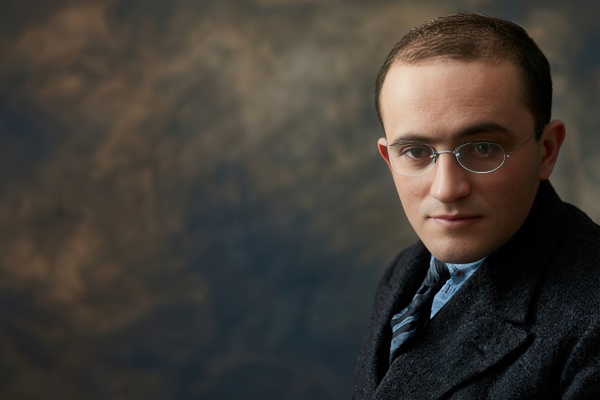
Armenian people and Armenia, if I forget you, let my tongue cleave to the roof of my mouth.
I am already rich with my wealth being my idea, my pen.
Andranik Ter-Ohanian was born on November 14, 1899, in Tabriz.
He received his primary education at his birthplace's "Aramyan" school, then studied at the St. Etchmiadzin "Gevorgian" Seminary.
He completes the seminary's course in 1917, in a very fateful period of the Armenian people's national-political life, when the Caucasian front was in an alarming state. In 1918, when Armenian national defense regiments were being organized to defend the endangered regions of Western Armenia, A. Ter-Ohanian enlists in the student volunteer company and leaves for Karin. However, as a result of the retreat that took place in March of the same year, A. Ter-Ohanian goes to Sarighamish, Kars, Ghara kilisa, then Tiflis, where he stays until 1919.
In the spring of 1919 he comes to Tabriz and from September of the same year devotes himself to the educational field, as a teacher of the native language. In 1919-1923 he joins the editorial staffs of the "Ayg" and "Arshaluys" newspapers and brings his active participation to the party work of the A.R.F. Azerbaijan region.
In 1923 he leaves for Czechoslovakia and attends the course of the law branch of the Russian section of the University of Prague. Two years later, in 1925, he leaves for Paris, where he attends the economics course of the Sorbonne University. In 1925-28 he contributes to the A.R.F. organ "Droshak" and the "Haratch" daily. During the same period he becomes the personal secretary of the great writer Avetis Aharonian and establishes close ties with the numerous intellectual figures and national and revolutionary prominent activists who were in Paris in those years, particularly with A. Aharonian and S. Vratsyan, undertaking the proofreading work of the former's work "My Book" and the latter's voluminous volume "The Republic of Armenia". In the same years he brings his active participation to the national, cultural and party work begun in the French-Armenian colony, assuming responsible duties.
In June 1928 he leaves for Yerevan via Moscow to go to Tabriz. However, during the journey, being arrested, he is subjected to imprisonment. Two years later, on June 21, 1930, being freed from imprisonment, he comes to Tabriz.
In 1931 he is invited to a teaching position at the Azerbaijan Diocesan Central School, and at the same time, brings his wholehearted participation to the national cultural and party life of Tabriz. In 1932-35 he assumes the presidency of the Tabriz Cultural Union, which played an important role in various areas of the local cultural life.
On the eve of the closing of the Armenian schools, which was carried out by order of Reza Khan, Andranik Ter-Ohanian was arrested several times and remained imprisoned for months. After the closing of the schools, Andranik, who could not remain indifferent, undertook the secret teaching of Armenian and during the same course compiled a new Armenian "Alphabet" and secretly printed it, and distributed it in the provinces.
In 1936 Andranik Ter-Ohanian is invited to work for the "Alik" editorial office and one year later, in 1937, he assumes the duties of editor of the same newspaper. In September 1942, during World War II, for reasons beyond his control, he resigns from the editorship and devotes himself to literary and publishing activities. He compiles and publishes native language manuals, as well as publishes the "Nor-Aghbyur" series of children's and youth reading booklets – in cooperation with the poet Vostanik.
On the eve of the Tehran Conference in the autumn of 1943, – which was to be convened in November of the same year with the participation of Churchill, Stalin and Roosevelt – Andranik Ter-Ohanian was arrested by the Tehran police at the request of the Soviet embassy, on a baseless accusation, according to which he was to have organized Stalin's terror. When Saed becomes the Prime Minister of Iran, the Soviet Embassy, by a letter, demands Andranik's handover to the Soviet authorities. This demand was justified by the fact that Andranik Ter-Ohanian had allegedly paid money to a person named Azhdar, entrusting him with the duty of assassinating Stalin. Subsequent investigations revealed that the so-called Azhdar had been in a prison in Egypt at the stated time. Andranik is released after about 20 months of imprisonment.
After being freed from prison, Andranik Ter-Ohanian again undertakes publishing work and publishes Armenian language textbooks following the "Alphabet".
In 1949 he edits and publishes the "Armenouhi" monthly, and at the same time brings his participation to the national-public and educational and cultural life of Tehran. In 1950-52 he is the president of the "Ararat" Cultural Union and for one year serves at the "Davtian Kushesh" school as a native language teacher.
In 1953 he is invited to the United States as an A.R.F. California region party activist and editor of the "Asbarez" newspaper. Until 1969 (with a one-year interruption) he holds that position, showing activity worthy of every appreciation. During those 16 years he brings his active participation to the national, cultural and party life of the California region, particularly giving impetus to the prosperity of "Asbarez" and supporting the founding of the same newspaper's new center. He also gives his moral support to other enterprises – the Fresno Armenian Home, the construction of clubs and churches founded in Los Angeles' "Ferahan" school and other cities, all the enterprises of the A.G.B.U. and the construction and maintenance work of the institutions founded in Fresno, Athens and Beirut by the benefactress Mrs. Sophia Yakobyan's donation, as well as the fundraising carried out in California for the Mekhitarist Congregations of Venice and Vienna in Antelias.
In 1965-66 he lectures at the Armenian Studies department of the University of Berkeley (California) and compiles a special manual for foreign students – in Eastern Armenian.
In 1969 he studies the vast archive of the tsarist "Okhrana" located at the California "Hoover Institution" and summarizes and translates the materials related to Armenian organizations (about 1100 pages), which are precious sources for our modern history.
In 1970, returning to Iran, he devotes himself to educational and cultural activities.
In 1973 he goes to Boston and, studying the A.R.F. archive, extracts and classifies historically valuable materials related to Iran's constitutional movement and the life and activities of the national hero Yeprem, which he completes in three volumes.
In 1972 he is elected president of the Iranian-Armenian Writers' Union, and in June 1974 he assumes the duties of editor of "Alik", while also lecturing at the Armenian Studies department of the University of Tehran.
He continues to carry out this triple duty with all dedication and spirit of sacrifice, for the realization of the Armenian people's national ideals and the prosperity of Armenian writing and literature.
Andranik Ter-Ohanian succeeded in going to Armenia as a tourist in the autumn of 1978 and seeing his beloved homeland.
On May 23, 1976, on the initiative of the Iranian-Armenian Writers' Union, the 55th anniversary of his activity was celebrated, under the auspices of the Diocesan Primate Archbishop Artak S. Manukian and with the participation of representatives of the unions operating in Tehran, as well as of associations.
Andranik Ter-Ohanian was one of the exceptional figures of Iranian-Armenians. He devoted his life entirely to his ideas and the Armenian people. He almost had no personal life and left a great legacy to future generations.
Respect to his memory.